
Posted on November 13, 2026 in
Health
The short answer: a medical office assistant keeps a clinic running on the administrative side. You answer phones, book and confirm appointments, check patients in, keep health records up to date, and handle billing and insurance claims. In some offices you also take vital signs or stock exam rooms. Most of the detail below comes from the Government of Alberta’s occupation profile, so check your own province’s description too.
If you’re reading this, you’re probably not after a job ad. You want to know what you’d actually be doing at 9:15 on a Tuesday, and whether you’d like it.
That’s a fair question to ask before you spend a year training. So here’s the job broken into the work itself, then a walk through an ordinary day.
What does a medical office assistant do?
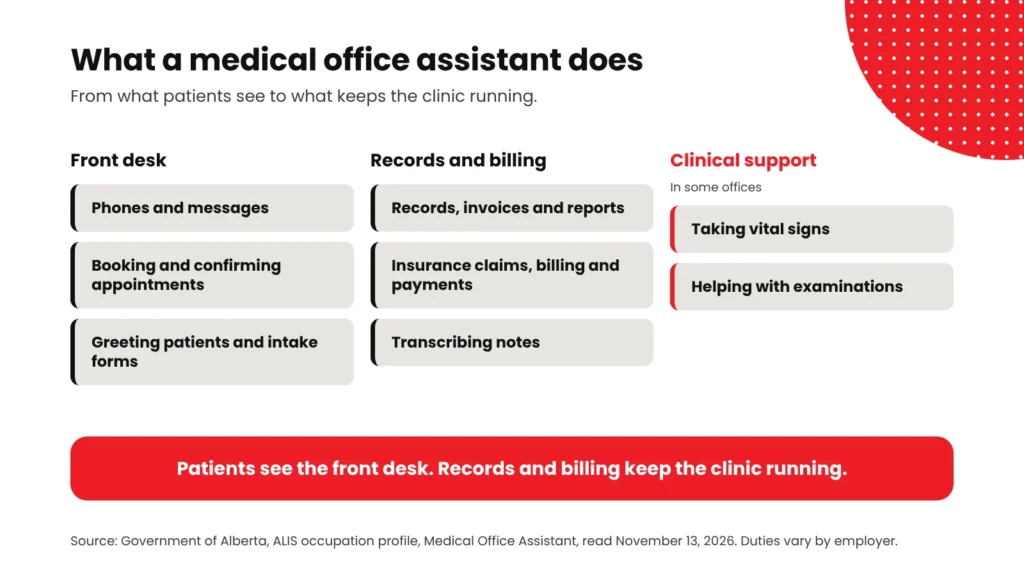
Think of the job in three layers. The front desk is what patients see. The records and billing work is what keeps the practice paid and legal. And in some offices, there’s a small clinical layer on top.
Alberta’s occupation profile lists duties across all three. It also notes that duties vary from one organization to another, and that large offices may split them among several people. A quiet specialist’s office and a busy walk-in clinic are both “medical offices,” and they don’t feel the same at all.
If you’ve been comparing this role with front-desk jobs, our post on medical receptionist vs. medical office assistant covers where the two split. This post stays on the duties themselves.
What are a medical office assistant’s front-desk duties?
This is the part of the job everyone pictures. It’s also the part that takes the most patience.
- Phones and messages. Answering calls, routing them, and taking messages for physicians and staff.
- Scheduling. Booking, confirming and rescheduling appointments, and fitting urgent patients into a full day.
- Greeting and check-in. Welcoming patients, confirming their details and getting intake forms completed.
- Keeping the day moving. Telling a patient the doctor is running late, and keeping them calm while you do it.
None of this is glamorous. All of it decides whether a patient walks out thinking the clinic is well run.
What are the records and billing responsibilities?
Here’s the part people underestimate. According to Alberta’s profile, medical office assistants use health software to prepare records, invoices, reports and intake forms. They also process insurance claims, billing and payments, transcribe notes, and keep records systems up to date.
In practice, that means reading what a physician wrote and getting it right. A billing code entered wrong is money the clinic doesn’t get. A chart filed in the wrong place is a patient whose history goes missing.
This is also where the role separates from general office work. Medical terminology, health records rules and provincial billing are specialist knowledge. We’ve covered how the MOA role differs from general admin work in more detail.
Do medical office assistants do any clinical tasks?
Sometimes, and less than people expect. Alberta’s profile says medical office assistants may take vital signs, help with examinations, and keep exam areas clean and stocked. The core of the job is still administrative.
If you want hands-on patient care to be most of your day, this probably isn’t the right job. If you’d like to work around healthcare without being the one giving it, it may suit you well.
What does a typical day look like?
No two clinics run the same, so treat this as an illustration. It’s a composite of a family-practice day built from the duties above, not a real person’s schedule.
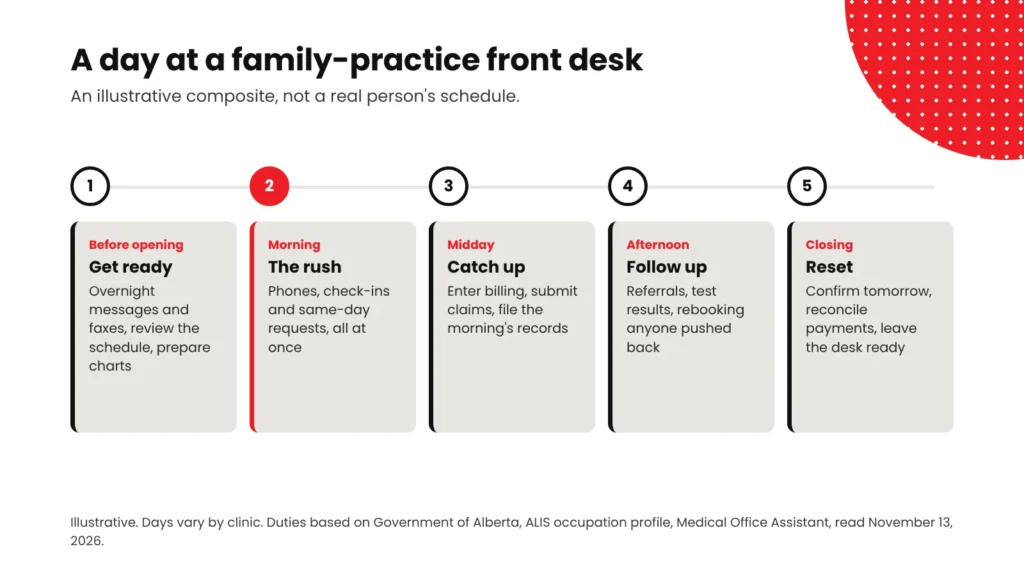
- Before opening. Check messages and faxes that came in overnight, review the day’s schedule, and pull or prepare charts for the first patients.
- The morning rush. Phones, check-ins and same-day requests arrive together. Most of your morning is triage of a non-clinical kind: who needs to be seen today, and who can wait.
- Midday. A quieter stretch, if you’re lucky. This is when billing gets entered, claims get submitted and the morning’s records get filed.
- Afternoon. Follow-up calls, referral paperwork, test results to route, and rebooking anyone the morning pushed back.
- Closing. Confirm tomorrow’s appointments, reconcile payments, and leave the desk ready for whoever opens.
Here’s what the list doesn’t show. Alberta’s profile says a significant part of the day is spent on your feet, and you may need to lift up to 10 kg. People working in doctors’ offices and hospitals may also be exposed to contagious illness. Some roles keep standard office hours, while others include evenings and weekends.
How do the duties change between a clinic and a hospital?
The tools are similar. The pace and the people aren’t.
In a clinic, you’re mostly dealing with patients and one or a few physicians. On a hospital unit, the closely related unit clerk role sits with nursing staff and handles the paperwork and phone traffic around the ward. If you’re weighing the two settings, we’ve compared the unit clerk and medical office assistant career paths separately.
What do employers expect before trusting you with these duties?
Alberta’s profile says there’s no provincial legislation regulating this occupation. That doesn’t mean anyone gets hired. Because no licence screens candidates, employers check skills directly.
The same profile says employers often look for a medical office assistant diploma or similar training. They also tend to expect a typing speed of at least 50 words a minute, with 60 preferred, and knowledge of medical terminology and anatomy. For the full list, see the top skills healthcare employers look for in medical office assistants.
Is this job a good fit for you?
The duties are the job. So the honest test is whether you’d enjoy doing them day after day.
It’s likely a good fit if:
- You like variety: phones, scheduling, records and billing in a single day.
- You stay calm when three things need you at once.
- You care about getting details exactly right, even when nobody’s checking.
- You want to work in healthcare without giving hands-on care.
It’s probably not a good fit if:
- You want a quiet desk job with long stretches of focused work.
- You need a fixed daytime schedule and can’t consider roles with evenings or weekends.
- You want clinical work to be most of your day.
For the trade-offs beyond daily duties, such as pay and outlook, see our pros and cons of being a medical office assistant.
How does training prepare you for these duties?
Most of the duties above map onto a specific part of a training program. ABM College’s Medical Office Assistant and Unit Clerk Diploma runs 54 weeks, including a 4-week practicum.
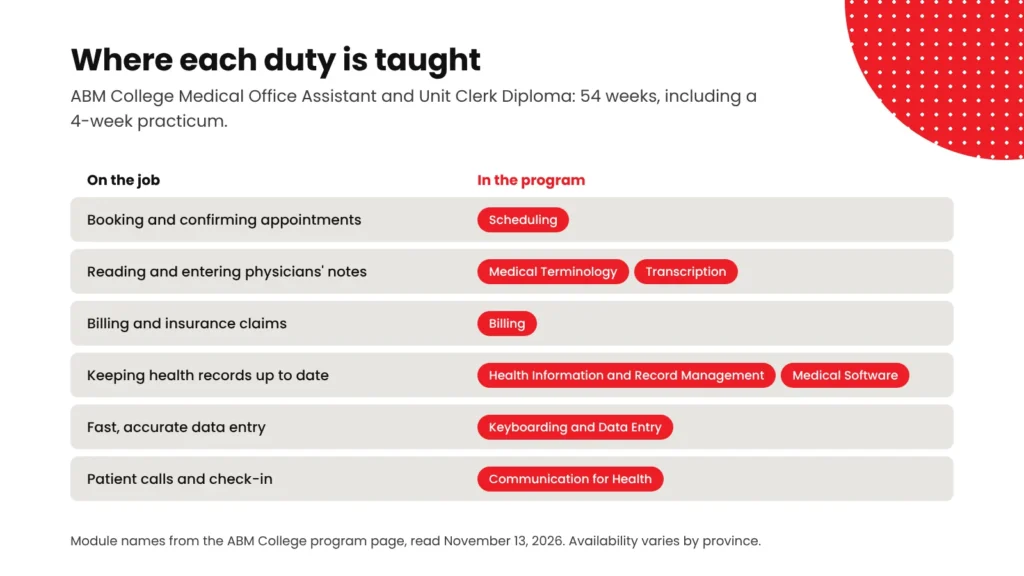
| Duty | Where it’s covered in the program |
|---|---|
| Booking and confirming appointments | Scheduling |
| Reading and entering physicians’ notes | Medical Terminology; Transcription |
| Billing and insurance claims | Billing |
| Keeping health records up to date | Health Information and Record Management; Medical Software |
| Fast, accurate data entry | Keyboarding and Data Entry |
| Patient calls and check-in | Communication for Health |
The practicum is where you try the duties in a real workplace, under supervision, before you apply for jobs. Delivery options vary by location, so ask Admissions what’s available in your province. If you’re near Calgary, the Calgary campus program page has the local details.
The bottom line
A medical office assistant’s job is the clinic’s front desk and the paperwork behind it, with a little clinical support in some offices. It’s busy, detail-heavy and rarely the same two days running.
So don’t decide from a duty list alone. Read ten live postings in your area and note how many mention billing, evenings or weekends, typing speed, or vital signs. If the work you see looks like work you’d want, you can explore ABM College’s Medical Office Assistant and Unit Clerk Diploma or contact Admissions. If it doesn’t, you’ve spent an afternoon finding out, not a year.
Further reading
- The MOA role in community healthcare
- Medical receptionist vs. medical office assistant
- Top skills for medical office assistants
Frequently asked questions
What are the duties and responsibilities of a medical office assistant?
According to Alberta’s occupation profile, they answer phones, book and confirm appointments, greet patients and take messages. They also use health software to prepare records, invoices, reports and intake forms, process insurance claims, billing and payments, transcribe notes and keep records systems up to date. Some also take vital signs and help with examinations.
What does a medical office assistant do day to day?
A typical day mixes front-desk work, such as phones, check-ins and scheduling, with records and billing work behind the desk. The balance depends on the workplace. Alberta’s profile notes that much of the day is spent on your feet, and some roles include evenings and weekends.
Do medical office assistants do clinical work?
Sometimes. Alberta’s profile says medical office assistants may take vital signs, help with examinations, and keep exam areas clean and stocked, but the core of the job is administrative.
What is the difference between a medical office assistant and a medical receptionist?
A receptionist mainly handles the front desk. A medical office assistant handles the front desk plus records, billing and claims. Employers sometimes use the titles loosely, so read each posting’s duties.
Do you need a licence to work as a medical office assistant?
In Alberta, the occupation profile says no provincial legislation regulates it. Employers often still expect a diploma or similar training, a typing speed of at least 50 words a minute and knowledge of medical terminology. Rules in other provinces can differ, so check yours.
How long is ABM College’s Medical Office Assistant and Unit Clerk Diploma?
54 weeks in total, including a 4-week practicum. Contact Admissions to confirm availability in your province.
About The Author

Kiran Vijay leads SEO at ABM College, working alongside admissions advisors and program teams across the Calgary, Winnipeg, and Toronto campuses. With 10+ years in SEO, paid search, and content strategy for Canadian post-secondary education, Kiran writes about diploma programs, career outcomes, and the job market for career college graduates — grounded in ABM College’s own enrolment and graduate employment data reported to Alberta Advanced Education. Connect on LinkedIn.