
Posted on August 7, 2026 in
Health
If you’ve been scrolling job boards, you’ve seen both titles. Sometimes on the same posting.
The short answer: a medical receptionist runs the front of a clinic — the phone, the schedule, the people walking through the door. A medical office assistant does that too, and then keeps going: billing, medical records, transcription, clinical paperwork, and in a hospital setting, the ward. Receptionist is a front-desk role. MOA is a front-desk-plus-back-office role. In practice the titles blur, and the blurring is what costs people money when they choose training.
Because here’s the part nobody says out loud: employers advertise these interchangeably, but they don’t pay or promote them interchangeably. If you’re weighing medical office assistant training in Canada against a shorter receptionist course, the difference between the two titles is the whole decision.
What does a medical receptionist do?
You are the clinic’s first point of contact, and most of the job is triage of a non-clinical kind.
Answering phones and routing calls. Booking, rescheduling and confirming appointments. Greeting patients and checking them in. Verifying health card details. Managing the waiting room when the doctor is running forty minutes behind and three people want to know why. Handling faxes and referrals coming in from other offices.
It’s a genuinely skilled job, and it’s harder than it looks from the waiting room. You’re the person who has to tell someone their appointment is in six weeks, not tomorrow, and keep them calm doing it.
What it usually isn’t: billing, chart management, or clinical documentation. Those live one desk over.
What does a medical office assistant do?
Everything above, plus the administrative machinery of the practice.
Billing and submitting claims to the provincial health plan. Maintaining medical records and health information. Medical transcription. Preparing charts before appointments. Handling diagnostic test requisitions and results. Understanding medical terminology well enough to read what a physician wrote and not guess. In hospital settings, unit clerk work — processing orders, coordinating with nursing units, managing patient movement on a ward.
That’s why the training runs longer. ABM College’s program is 54 weeks and covers medical terminology, billing, scheduling, medical software, transcription, health information and record management, pharmacology, and a four-week practicum. A receptionist course is typically a fraction of that, because it’s teaching a fraction of the job.
For a fuller picture of where the role sits in the health system, we’ve written about the MOA role in community healthcare separately.
So what’s the actual difference?
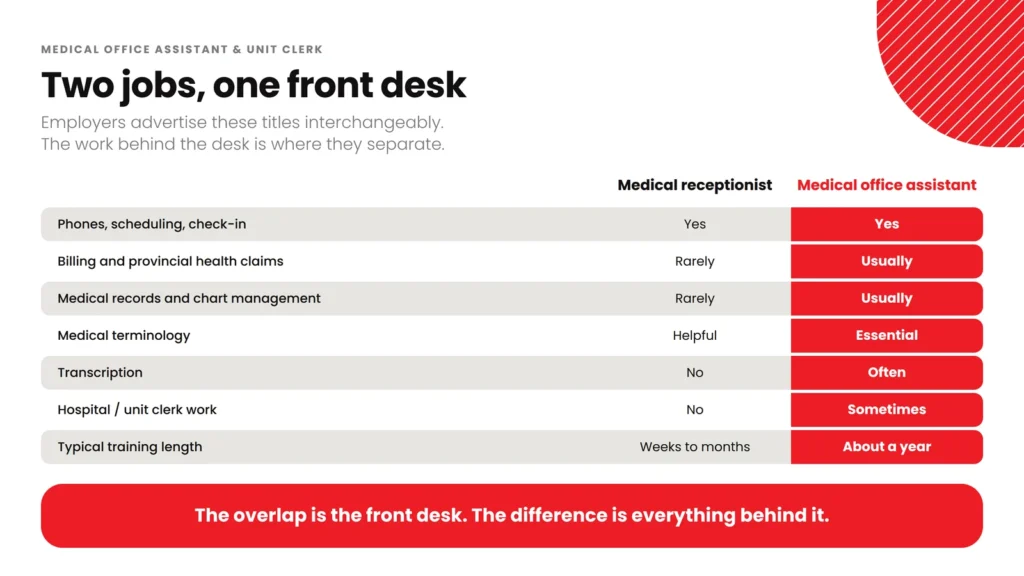
One line: a receptionist manages the front desk, an MOA manages the front desk and the paperwork behind it.
| Medical receptionist | Medical office assistant | |
|---|---|---|
| Phones, scheduling, check-in | Yes | Yes |
| Billing and provincial health claims | Rarely | Usually |
| Medical records and chart management | Rarely | Usually |
| Medical terminology required | Helpful | Essential |
| Transcription | No | Often |
| Hospital / unit clerk work | No | Sometimes |
| Typical training length | Weeks to months | Around a year |
The overlap at the top of that table is why the titles get used loosely. The gap at the bottom is why they aren’t the same job.
And the difference is narrower in small clinics than in large ones. At a two-physician family practice, one person may do all of it regardless of what the title says. At a hospital or a multi-site clinic group, the roles separate cleanly. This mirrors how the MOA role differs from general admin work — the smaller the employer, the wider your job.
Do they get paid differently?
Generally yes, and the reason is the billing and records work rather than the front desk work.
We’re not going to quote you a national average, because it would be close to useless — the range across a rural family practice and an urban hospital is wide, and it varies by province and experience.
Here’s how to get a real number instead. Go to the Government of Canada’s Job Bank, search “medical administrative assistant” and “receptionist” separately, and filter to your own city or province. You’ll get low, median and high wages for where you’d actually be working, from the federal source. Then cross-check against live postings for the same titles in your area.
Twenty minutes of that will tell you more about your local market than any national figure could.
Which job titles should you actually search for?
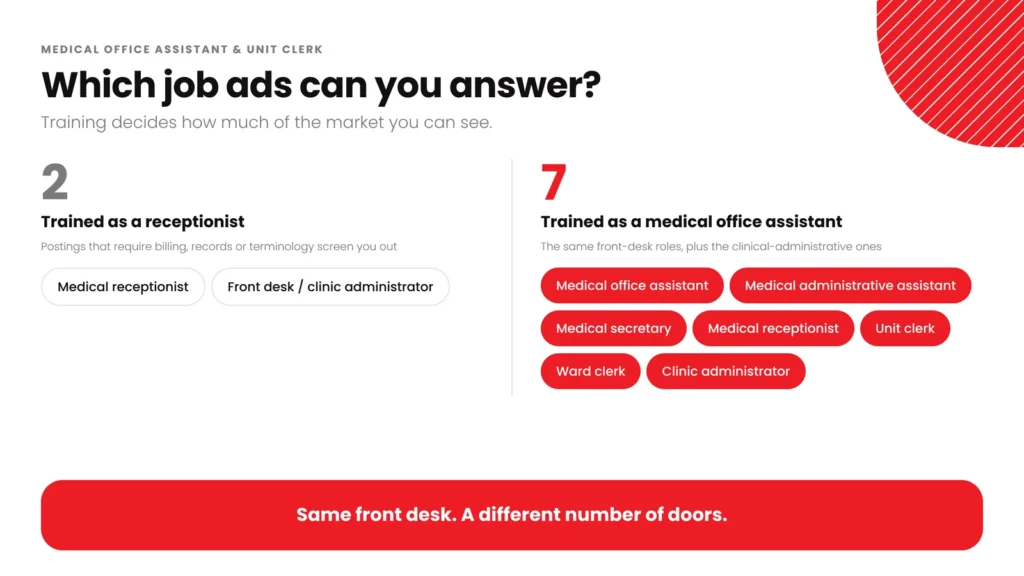
This matters more than people expect, because searching the wrong title hides half the market from you.
If you train as an MOA, you are qualified to apply for postings advertised as: medical office assistant, medical administrative assistant, medical secretary, medical receptionist, unit clerk, ward clerk, health services aide (administrative), and clinic administrator at smaller practices.
If you train only as a receptionist, the list is shorter, and the postings that mention billing, EMR management or terminology will screen you out — often automatically, before a human reads your application.
That asymmetry is the practical case for the longer training. Not that it guarantees you anything, but that it stops doors closing before you’ve knocked.
Do you need formal training to be a medical receptionist in Canada?
Not legally. Neither role is a regulated or licensed profession in Canada, and there’s no protected title or mandatory certification for either.
That cuts both ways. It means you can be hired as a medical receptionist without a credential, particularly at a small clinic willing to train you. It also means employers screen hard on demonstrated skills, because there’s no licence doing the screening for them. Terminology, billing systems and EMR competence are what get checked.
So the honest framing is: training isn’t required, it’s competitive. Which is a different argument, and a weaker one than “you must have this” — but it’s the true one.
Which one should you train for?
Here’s where it’s worth being blunt about who each path suits.
A receptionist course probably makes sense if:
- You want to be working in months rather than a year
- You’re testing whether healthcare administration suits you before committing
- You have a specific small-clinic opportunity already in view
- Budget is the binding constraint right now
MOA training probably makes sense if:
- You want access to hospital and unit clerk roles, not just clinic front desks
- You’d rather not re-train in two years when you hit the billing ceiling
- You want the wider list of job titles you can credibly apply for
- You learn better with a practicum than by being thrown in
Be honest on that first list. There’s no shame in the shorter route, and it’s cheaper to start there deliberately than to over-buy training you didn’t need.
If you’re still deciding whether the field itself fits, whether a MOA career fits you is the better place to start than either course page.
For the longer route, ABM College’s Medical Office Assistant and Unit Clerk Diploma runs 54 weeks with a four-week practicum, online, in-person or hybrid, in morning, evening or weekend blocks. ABM College reported that 71.43% of graduates from this program secured field-related employment to Alberta Advanced Education for the 2024–25 reporting year. That figure describes one program in one reporting year and isn’t a prediction about any individual student — ask any college you’re considering for its most recent number and how many graduates it’s based on. A percentage without a denominator tells you very little.
Three questions to ask before you enrol anywhere
“Does this cover medical billing and provincial health claims, and for how many hours?” This is the single clearest line between the two roles. A course that mentions billing is not the same as one that trains it.
“Is there a practicum, and is it guaranteed or competitive?” Ask whether every student is placed, or whether placements are limited. The answer tells you a lot.
“Which job titles have your recent graduates been hired into?” Not “where do graduates work” — which titles. If the answer is only receptionist roles, you’re paying MOA prices for receptionist outcomes.
Those questions work on us as well as on anyone else. That’s the point of them.
The honest version
These are two different jobs wearing similar names, and the labour market mostly knows it even when the job ads don’t.
The receptionist job is real, skilled, and a legitimate way into healthcare. The MOA job is the same work plus the administrative spine of a practice — billing, records, terminology, and in hospitals, the ward. One takes months to train for. The other takes about a year.
So the question isn’t which title sounds better. It’s how many doors you want open when you start applying, and whether you’d rather pay for the wider set now or the narrower set twice.
Look up both titles on Job Bank for your own city. Read ten live postings for each and count how many mention billing or EMR. Then decide with the postings in front of you, not the job title.

FAQ
What is the difference between a medical receptionist and a medical office assistant? A medical receptionist manages the front desk of a clinic — answering phones, booking and confirming appointments, checking patients in, and verifying health card information. A medical office assistant does that work and also handles the administrative side of the practice: billing and provincial health claims, medical records and health information management, transcription, chart preparation, and in hospital settings, unit clerk duties. The roles overlap at the front desk and separate in the back office.
Is a medical receptionist the same as a medical office assistant in Canada? No, although employers often advertise the titles interchangeably. The practical difference is billing and records work. At a small clinic one person may do both jobs regardless of title. At a hospital or larger clinic group, they are usually separate positions with different training expectations.
Do you need a certificate to work as a medical receptionist in Canada? No. Neither medical receptionist nor medical office assistant is a regulated or licensed profession in Canada, and there is no protected title or mandatory certification for either. Because no licence does the screening, employers tend to screen closely on demonstrated skills instead — particularly medical terminology, billing systems, and electronic medical records.
Which job titles can a medical office assistant apply for? Postings that suit MOA training are commonly advertised as medical office assistant, medical administrative assistant, medical secretary, medical receptionist, unit clerk, ward clerk, and clinic administrator at smaller practices. Someone trained only for reception work is generally screened out of postings that require billing, records management or medical terminology.
Does a medical office assistant earn more than a medical receptionist? Generally yes, and the difference is usually attributed to the billing and records responsibilities rather than the front-desk work. Wages vary widely by province, employer type and experience, so the reliable way to check is the Government of Canada’s Job Bank, searching each title separately and filtering to your own city or province.
How long does it take to train as a medical office assistant in Canada? Programs vary. ABM College’s Medical Office Assistant and Unit Clerk Diploma runs 54 weeks and includes a four-week practicum, delivered online, in person or hybrid. Receptionist-focused courses are typically much shorter because they cover a narrower set of duties.
About The Author

Kiran Vijay leads SEO at ABM College, working alongside admissions advisors and program teams across the Calgary, Winnipeg, and Toronto campuses. With 10+ years in SEO, paid search, and content strategy for Canadian post-secondary education, Kiran writes about diploma programs, career outcomes, and the job market for career college graduates — grounded in ABM College’s own enrolment and graduate employment data reported to Alberta Advanced Education. Connect on LinkedIn.