
Posted on October 23, 2026 in
Health
The short answer: it’s a varied, healthcare-adjacent job with real limits. On the plus side, Alberta doesn’t regulate the occupation, the work mixes phones, scheduling, records and billing, and Alberta’s three-year outlook is rated “Hot.” On the minus side, you’re on your feet much of the day, you may be exposed to contagious illness, some roles include evenings and weekends, and the pay range has a ceiling. Most figures below come from Alberta’s occupation profile, so check your own province before you decide.
If you’re searching this, you’re probably asking three things. Will I like the work? Will it pay enough? Will there be a job?
We can help with the first and give you dated figures for the second. For the third, we can tell you what one province’s forecast says, and how to check yours.
What are the pros of being a medical office assistant?
You don’t need a licence to start. The Government of Alberta’s occupation profile says there is no provincial legislation regulating the occupation. That doesn’t mean training is irrelevant: the same profile says employers often expect a medical office assistant diploma or similar training, along with typing speed and medical terminology. It means you can go from a program to a job without an exam standing in between.
The work has variety. According to the profile, a medical office assistant answers phones, books and confirms appointments, greets patients and takes messages. They also use health software to prepare records, invoices and reports, process insurance claims and billing, transcribe notes, and keep records systems up to date. If a day of one task sounds dull to you, this job rarely asks for that.
Alberta’s outlook is rated “Hot.” The profile cites the 2024–2026 Alberta Short-Term Employment Forecast and expects turnover to rise as baby boom workers retire. The forecast covers the wider occupation group, which also includes unit clerks, and it describes Alberta only. A rating isn’t a promise that you’ll be hired.
There are published pay figures. Alberta’s 2023 Wage and Salary Survey puts the average starting wage for this occupation group at $23.57 an hour and the overall average at $27.55.
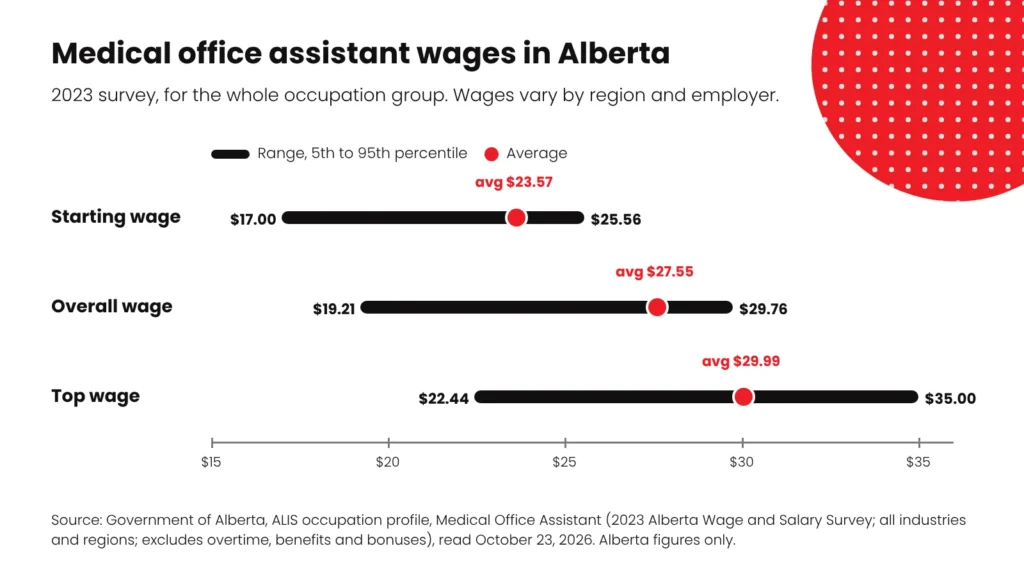
| Alberta, hourly (2023 survey) | Low (5th percentile) | Average | High (95th percentile) |
|---|---|---|---|
| Starting wage | $17.00 | $23.57 | $25.56 |
| Overall wage | $19.21 | $27.55 | $29.76 |
| Top wage | $22.44 | $29.99 | $35.00 |
Source: Government of Alberta, ALIS occupation profile, Medical Office Assistant (2023 Alberta Wage and Salary Survey; data covers the occupation group, all industries and regions; excludes overtime, benefits and bonuses). Read October 23, 2026.
What are the cons of being a medical office assistant?
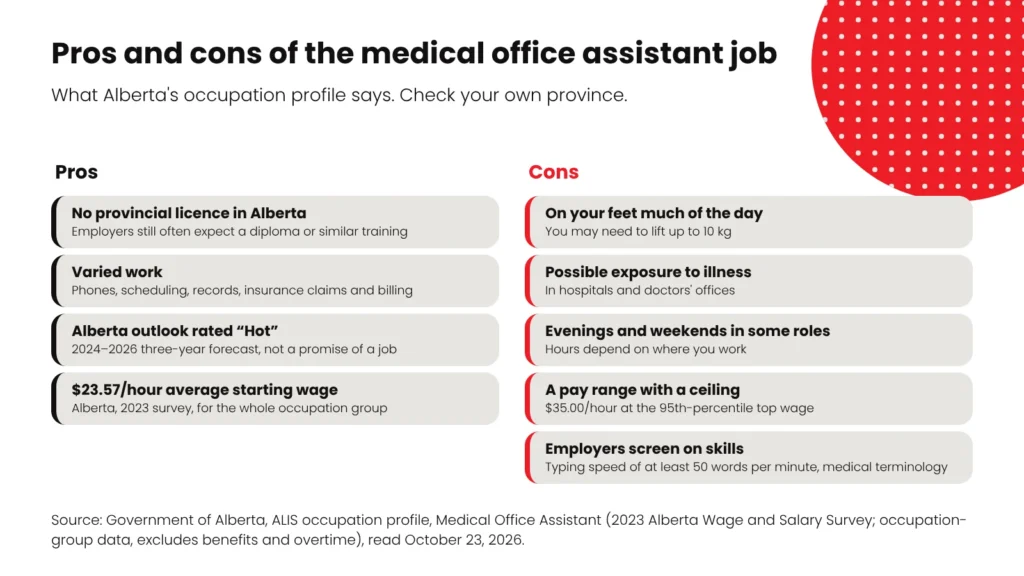
It’s more physical than people expect. The profile says a significant part of the day is spent on your feet and that you may need to lift up to 10 kg. If you’re picturing a desk job, ask to see a working front desk and a supply room.
You may be exposed to illness. The profile notes that people working in hospitals and doctors’ offices may often be exposed to contagious diseases. That comes with the setting, not the job title.
Your hours depend on where you work. Alberta’s profile describes standard office hours in some roles and evenings and weekends in others. For the closely related unit clerk role, which the same diploma prepares you to apply for, the unit clerk profile describes mostly day and evening shifts with some rotating shifts including nights and weekends, in shifts of 4, 8, 10 or 12 hours.
It can be stressful. Alberta’s unit clerk profile calls the hospital unit environment busy and emotionally stressful. The medical office assistant profile doesn’t say the same, and a quiet family practice differs from a ward. Ask how busy a workplace runs before you accept a job there.
Pay has a ceiling, and the figures leave things out. In the 2023 survey, the 95th-percentile top wage was $35.00 an hour. The figures exclude benefits, overtime and bonuses, so they understate or overstate your actual package depending on the employer. And they’re Alberta figures, so wages elsewhere can differ.
Employers screen hard, because no licence does it for them. Because the occupation isn’t regulated, employers check skills directly. Alberta’s profile says they often expect typing speeds of at least 50 words per minute (60 preferred) with few errors, and knowledge of medical terminology and anatomy. Training helps, but you still have to show the skills.
Are medical office assistants in demand?
In Alberta, the three-year forecast is rated “Hot” for the occupation group. Other provinces and cities differ, sometimes a lot. Check the employment outlook for your own region on the Government of Canada’s Job Bank, then read ten live postings in your area. Training doesn’t guarantee a job.
Is a medical office assistant a good career?
It depends on which of the cons you can live with. For the right person, it’s a steady route into healthcare administration without a degree. For the wrong one, it’s a job with a pay ceiling and shifts they didn’t expect.
It’s likely a good fit if:
- You like variety, such as phones, scheduling, records and billing in one day.
- You can handle being on your feet and some time around people who are ill.
- You’re comfortable with evenings or weekends if the workplace needs them, or you’ve checked that it doesn’t.
- You’re willing to build typing speed and learn medical terminology.
It’s probably not a good fit if:
- You want pay that is certain to keep climbing, rather than a range with a ceiling.
- You need a fixed daytime schedule and can’t take a role with rotating shifts.
- You want mainly clinical work. Some offices have medical office assistants take vital signs, according to Alberta’s profile, but the core of the job is administrative.
If you’d like to see how the role differs from front-desk work, we’ve compared it with a medical receptionist and with general admin work. For the skills employers screen on, see our guide to the top skills for medical office assistants.
What does medical office assistant training involve at ABM College?
ABM College’s Medical Office Assistant and Unit Clerk Diploma runs 54 weeks, including a 4-week practicum. Its 16 modules include Billing, Scheduling, Medical Terminology, Medical Software, Health Information and Record Management, Transcription, Keyboarding and Data Entry, and Communication for Health. The program page lists online, in-person and hybrid delivery with morning, evening and weekend options. Ask Admissions what’s available in your province. If you’re near Calgary, the Calgary campus program page has the details for that location.
What about employment after the program?
ABM College reports that 71.43% of its Medical Office Assistant and Unit Clerk graduates secured field-related employment after completing the program, based on its 2024–25 graduate outcomes (April 2024 to March 2025), which the college submits to the Government of Alberta.
That is a past result for one group of graduates, not a prediction or a guarantee for you. Ask Admissions for the report and how “field-related” is defined.
The Bottom Line
The job’s strengths and weaknesses are the same thing seen from two sides. The variety that keeps it interesting is also what keeps you on your feet, and the setting that gives you steady work also exposes you to illness and shifts.
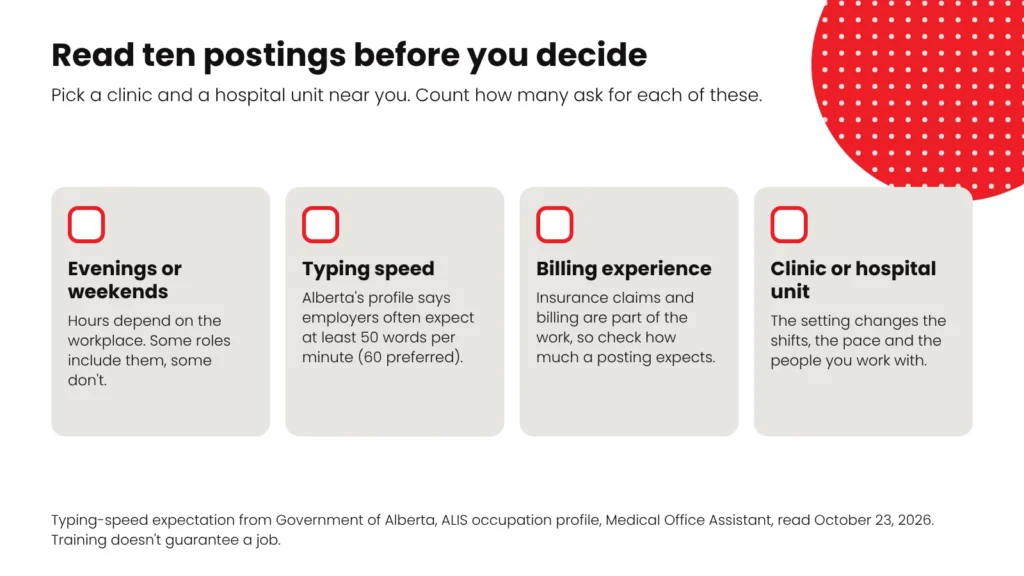
So don’t decide from a list. Pick two workplaces you could see yourself in, a clinic and a hospital unit, and read the postings for both. Count how many ask for evenings or weekends, for typing speed, and for billing experience. If what you see matches a 54-week diploma with a practicum, you can explore ABM College’s Medical Office Assistant and Unit Clerk Diploma, see the Calgary program page, or contact Admissions to check availability in your province. If it doesn’t, you’ve lost an afternoon, not a year.
Further reading:
- Top 10 skills healthcare employers look for in medical office assistants
- Medical receptionist vs. medical office assistant
- How the medical office assistant role differs from general admin work
Frequently Asked Questions
What are the pros and cons of being a medical office assistant?
According to Alberta’s occupation profile, the pros include no provincial licence requirement, varied administrative work, and a three-year employment forecast rated u0022Hotu0022 in Alberta. The cons include spending much of the day on your feet, possible exposure to contagious illness, evenings and weekends in some roles, a pay range with a ceiling, and employers who screen closely on typing speed and medical terminology.
Is a medical office assistant a good career?
It depends on which trade-offs suit you. It offers varied work and a route into healthcare administration without a degree, but it can be physical, can include evening and weekend hours, and has a pay range with a ceiling. Reading live postings in your area is the best way to judge the fit.
Is being a medical office assistant stressful?
It varies by workplace. Alberta’s profile for the closely related unit clerk role calls hospital unit work busy and emotionally stressful, while its medical office assistant profile doesn’t make that statement. Ask how busy a workplace runs before you accept a job there.
Do medical office assistants need a licence?
In Alberta, the occupation profile says no provincial legislation regulates it. Employers still tend to expect a diploma or similar training, typing speed and medical terminology. Rules in other provinces can differ, so check yours.
How much do medical office assistants make in Alberta?
Alberta’s 2023 Wage and Salary Survey puts the average starting wage for the occupation group at $23.57 an hour and the overall average at $27.55, with a 95th-percentile top wage of $35.00. These figures cover the wider occupation group and exclude benefits, overtime and bonuses, and wages vary by region and employer.
How long is ABM College’s Medical Office Assistant and Unit Clerk Diploma?
54 weeks in total, including a 4-week practicum. Contact Admissions to confirm availability in your province.
What is the employment rate for ABM College’s Medical Office Assistant and Unit Clerk graduates?
ABM College reports that 71.43% of its Medical Office Assistant and Unit Clerk graduates secured field-related employment after completing the program, based on its 2024–25 graduate outcomes (April 2024 to March 2025), which the college submits to the Government of Alberta. That is a past result for one group of graduates, not a prediction or a guarantee for you. Ask Admissions for the report and how u0022field-relatedu0022 is defined.
About The Author

Kiran Vijay leads SEO at ABM College, working alongside admissions advisors and program teams across the Calgary, Winnipeg, and Toronto campuses. With 10+ years in SEO, paid search, and content strategy for Canadian post-secondary education, Kiran writes about diploma programs, career outcomes, and the job market for career college graduates — grounded in ABM College’s own enrolment and graduate employment data reported to Alberta Advanced Education. Connect on LinkedIn.