
Posted on July 29, 2026 in
Health
Finding a one-year diploma program in Canada is the easy part. There are dozens, and every college publishes a list.
Choosing one is harder, and most lists don’t help. They tell you a program exists, how long it takes, and that graduates get hired — which is true of nearly all of them, and therefore useless for deciding. If you’re weighing four or five options, what you actually need to know is what the work feels like, which kind of person tends to do well in it, and which kind quietly regrets the choice eighteen months in.
That’s what this guide is for. If you’re still deciding whether a diploma is the right route at all, start with are career colleges worth it in Canada instead — this article assumes you’re past that question and down to which one.
First, ignore what all of these programs have in common
Most one-year diploma programs at a Canadian career college share the same shape. At ABM College, for instance, the programs below all run roughly 40 to 56 weeks, are delivered online through live instructor-led classes, include a practicum, and start on rolling monthly intakes rather than in September.
That matters — but because it’s true of all of them, it can’t help you choose between them. So set it aside. The real differences are elsewhere.
The question that actually narrows it down
Not “which pays the most.” Not “which is fastest.” Ask instead:
What do you want to be doing at 10 a.m. on a Tuesday?
It sounds soft. It’s the most practical question on this page, because a year from now that Tuesday is your life — and the difference between a clinic reception desk, a Grade 3 classroom, a pharmacy counter, and a quiet desk with a spreadsheet open is enormous. Program length is nearly identical across all four. The Tuesday is not.
Below are four kinds of Tuesday.
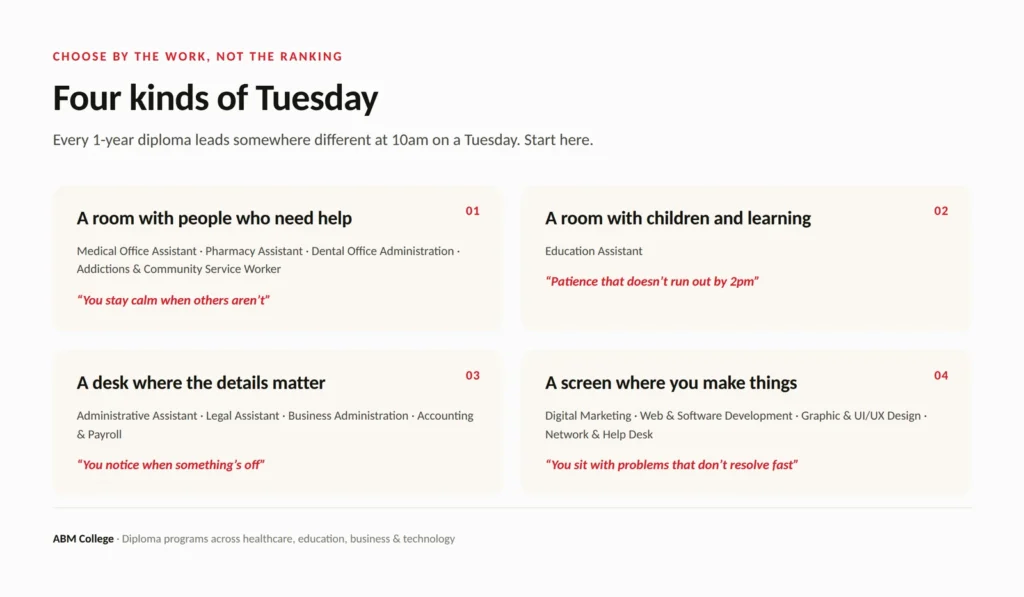
1. A room with people who need help
The work: You’re the first person someone meets on what may be a stressful day. Medical office assistants run the front of a clinic — booking, records, phones, patients who are worried and sometimes short-tempered. Pharmacy assistants work the counter and the dispensary, handling prescriptions, inventory, and the customer who’s been waiting eight minutes. Dental office administrators do the same for a dental practice. Addictions and community service workers sit with people in genuine crisis.
You’ll likely do well if you stay calm when other people aren’t, you don’t mind being interrupted constantly, and being useful to someone face-to-face is what makes a day feel worthwhile.
It will be harder if you need long stretches of uninterrupted focus, or if absorbing other people’s stress tends to follow you home. This is real and worth being honest with yourself about — especially for community service work, where emotional weight is part of the job, not a side effect of it.
Programs: Medical Office Assistant & Unit Clerk (54 weeks) · Pharmacy Assistant (53 weeks) · Dental Office Administration (53 weeks) · Addictions & Community Service Worker (56 weeks)
Where graduates train: ABM College practicum placements in this stream have included medical clinics across Alberta, pharmacy employers including Shoppers Drug Mart, Rexall, Costco Wholesale Pharmacy and Sandstone Pharmacies, dental practices, and community organizations such as The Mustard Seed and the Calgary Drop-In Centre.
2. A room with children and learning
The work: Education assistants support students with diverse learning needs — sometimes one child for most of a day, sometimes a small group, always in partnership with a teacher. It’s physical, it’s loud, and progress is measured in small increments over months.
You’ll likely do well if you’re patient in a way that doesn’t run out by 2 p.m., you can take direction from a teacher while thinking independently, and slow progress with one child feels like a win rather than a plateau.
It will be harder if you want visible results by Friday, or you’d find it frustrating to work within someone else’s lesson plan. One practical note: this is a school-calendar job, which means summers off and, for many roles, ten months of pay rather than twelve. That’s a real trade — excellent for some households, difficult for others.
Program: Education Assistant (53 weeks)
Where graduates train: Placements have included the Calgary Board of Education, the Calgary Roman Catholic Separate School Division, Edmonton Public Schools, and a range of individual schools, daycares and early learning centres.
3. A desk where the details matter
The work: Somebody keeps an organization from falling apart, and it’s usually this person. Administrative assistants manage calendars, correspondence, documents and the small crises. Legal assistants prepare filings and correspondence where a wrong date has consequences. Accounting and payroll administrators reconcile the numbers and make sure everyone gets paid correctly. Business administration is the broadest of the four, covering operations, bookkeeping, marketing fundamentals and business software.
You’ll likely do well if you notice when something is slightly off, you’d rather own a system than be handed one, and you take quiet satisfaction in a thing being correct.
It will be harder if repetition drains you, or if you want work that visibly changes week to week. And a candid note on Legal Assistant: deadlines in a law office are externally imposed and immovable, which suits some people and grinds on others.
Programs: Administrative Assistant (53 weeks) · Legal Assistant (54 weeks) · Business Administration (55 weeks) · Accounting & Payroll Administration (55 weeks)
Worth knowing: this stream travels the widest. Administrative skills transfer across healthcare, law, construction, non-profits and government, which makes it the most flexible starting point if you’re not certain what industry you want to end up in.
4. A screen where you make things
The work: Long stretches of focus, work you can point at when it’s finished, and a field that expects you to keep learning after graduation. Digital marketing runs campaigns and measures them. Graphic design and UI/UX design shape how things look and how they’re used. Web and software development build them. Network administrators and help desk analysts keep the systems everyone else depends on running.
You’ll likely do well if you can sit with a problem that doesn’t resolve quickly, you’re comfortable being a beginner repeatedly as tools change, and you like finishing things.
It will be harder if you want a role that’s fully learned within a year. This stream has the steepest ongoing learning curve of the four — the diploma opens the door, and the field keeps moving after you walk through it. Tech hiring is also more portfolio-driven than credential-driven, so what you build during the program matters as much as finishing it.
Programs: Mobile App Developer (40 weeks) · Digital Marketing (46 weeks) · Graphic Design (53 weeks) · Help Desk Analyst (53 weeks) · UI/UX Design (53 weeks) · Network Administrator (54 weeks) · Web Design & Development (54 weeks) · Software Development (56 weeks)
Where graduates train: Placements have included IT firms such as CGI, SysGen Solutions Group and CompuVision, alongside marketing agencies and in-house teams.
(If you’re drawn to cybersecurity, note that ABM College’s Cybersecurity diploma runs 70 weeks — closer to sixteen months than twelve, so it sits outside the scope of this guide.)
Side by side
| Program | Length | Your Tuesday | Suits you if | Trade-off to weigh |
| Medical Office Assistant & Unit Clerk | 54 wk | Clinic front desk | You’re calm under interruption | Constant task-switching |
| Pharmacy Assistant | 53 wk | Pharmacy counter & dispensary | You like precision plus people | Retail hours, standing |
| Dental Office Administration | 53 wk | Dental practice front office | You want a smaller, steady team | Narrower job pool |
| Addictions & Community Service Worker | 56 wk | Community or recovery setting | Purpose matters more than pace | Real emotional weight |
| Education Assistant | 53 wk | Classroom | Patience is a strength of yours | School calendar, 10-month pay |
| Administrative Assistant | 53 wk | Office, many moving parts | You’d rather own the system | Can feel behind the scenes |
| Legal Assistant | 54 wk | Law office | Accuracy is satisfying | Immovable deadlines |
| Business Administration | 55 wk | Varies widely | You’re not sure yet — good | Less specialised on day one |
| Accounting & Payroll Administration | 55 wk | Numbers, cycles, deadlines | You like closing the books | Cyclical crunch periods |
| Digital Marketing | 46 wk | Campaigns and analytics | You like measurable creativity | Field changes constantly |
| Graphic Design / UI/UX Design | 53 wk | Design work | Craft matters to you | Portfolio-driven hiring |
| Help Desk Analyst | 53 wk | Support queue | You like solving and explaining | Reactive, ticket-paced |
| Network Administrator | 54 wk | Systems and infrastructure | You want things to just work | On-call in some roles |
| Web Design & Development | 54 wk | Building sites | You like finishing things | Ongoing learning expected |
| Software Development | 56 wk | Writing code | Problems that don’t resolve fast | Steepest learning curve |
| Mobile App Developer | 40 wk | App builds | Shortest route in this list | Smallest cohort — ask about it |
All programs above are delivered online with a practicum. Lengths are from ABM College program pages, July 2026.
What placement rates can — and can’t — tell you
Career colleges publish graduation and job placement rates, and it’s worth asking for them. But read them carefully, because a percentage without a denominator can mislead.
ABM College reports these figures annually to Alberta Advanced Education. In 2024–25, among the larger programs:
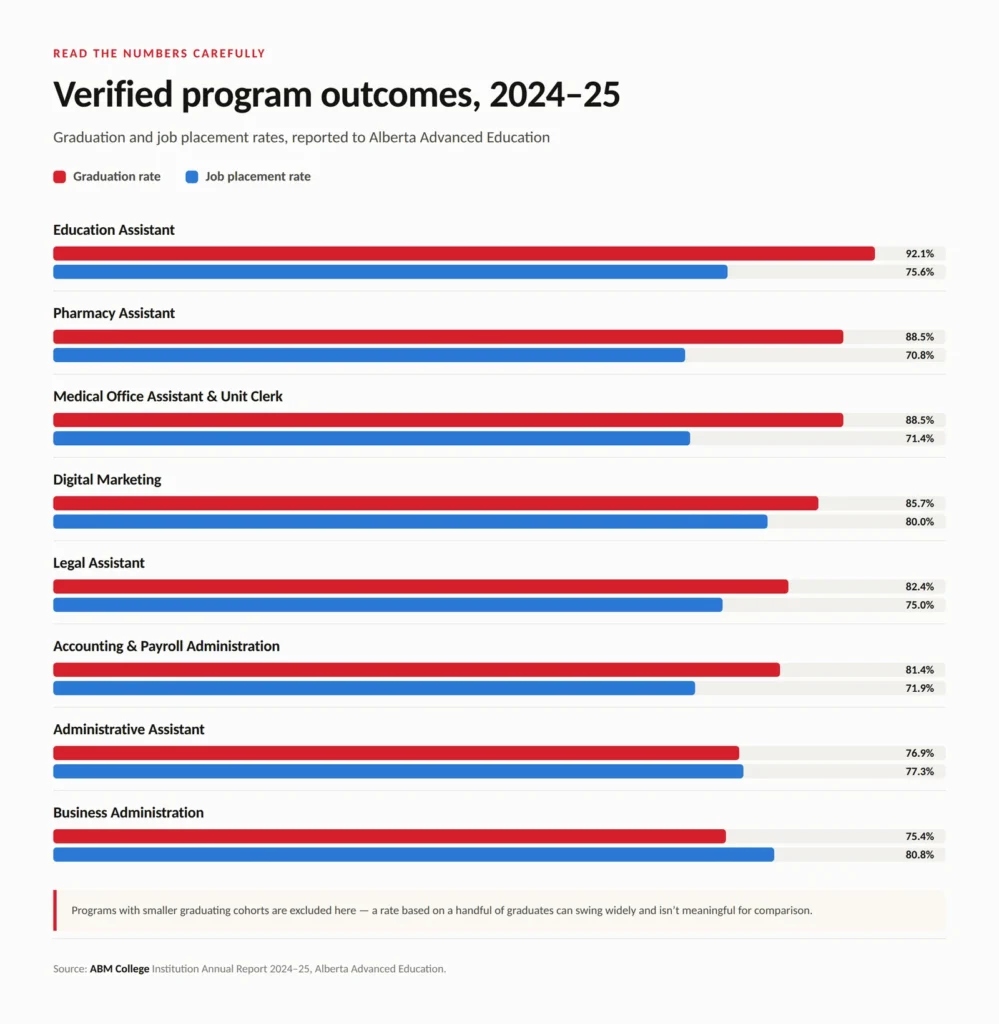
| Program | Graduation rate | Job placement rate |
| Education Assistant | 92.1% | 75.6% |
| Pharmacy Assistant | 88.5% | 70.8% |
| Medical Office Assistant & Unit Clerk | 88.5% | 71.4% |
| Digital Marketing | 85.7% | 80.0% |
| Legal Assistant | 82.4% | 75.0% |
| Accounting & Payroll Administration | 81.4% | 71.9% |
| Administrative Assistant | 76.9% | 77.3% |
| Business Administration | 75.4% | 80.8% |
Source: ABM College Institution Annual Report 2024–25, Alberta Advanced Education.
Three things to keep in mind when you compare numbers like these — at any college:
Small cohorts distort percentages. A program where four graduates were tracked can show 75% or 100% depending on a single person. Some of ABM College’s smaller programs fall into this range, which is why they aren’t in the table above — not because the numbers are unflattering, but because they aren’t meaningful at that sample size. Always ask how many graduates a rate is based on.
“Placement” is a defined term, not a promise. It reflects graduates employed within a tracking window, by a specific definition, in a specific year. It doesn’t tell you about wages, hours, or whether the job was the one someone wanted.
One year isn’t a trend. Ask for two or three years of figures for the specific program you’re considering. A college that reports to a provincial regulator will have them.
Nobody can promise you a job — not a career college, not a university. What a published, regulator-reported rate does tell you is that a college is willing to be measured. That’s a reasonable thing to expect before you commit a year.
Three questions to ask before you commit
Can you picture the Tuesday — from something other than a brochure? Ask an admissions advisor to connect you with a graduate, or find someone doing the job on LinkedIn and ask for fifteen minutes. One honest conversation about the boring parts is worth more than any program page, including ours.
Does the schedule survive contact with your actual life? “Flexible” means different things. Get specific: which nights, how many hours of coursework outside class, and when the practicum falls — practicums are usually daytime, which is the part working students most often underestimate.
What does year three look like? A first job is a starting point. Ask where graduates of that specific program tend to be two or three years later, and whether the credential stacks toward anything further.
Choose for the Tuesday
Every program on this list ends the same way: a diploma in about a year, in a field that hires. Sort them by length and they’re nearly identical. Sort them by placement rate and you’re comparing percentages separated by a few points and a few graduates.
What actually differs is the middle — the ten months you spend getting there, and the Tuesday morning waiting on the other side. One of these is a classroom with a child who just got something right. One is a pharmacy counter at 4 p.m. One is a quiet desk and a set of books that balance.
A year is short enough that the wrong choice costs you a year. It’s also short enough that the right one arrives sooner than you’d think. Pick the Tuesday you’d want, then find the program that leads to it — not the reverse. Browse ABM College’s diploma programs by field, or talk to an admissions advisor about how a specific program’s schedule and practicum would fit around your life. If cost is the open question, financial aid options — including government student loans and, for permanent residents new to Canada, Windmill Microlending — are worth reviewing before you decide.

About The Author

Kiran Vijay leads SEO at ABM College, working alongside admissions advisors and program teams across the Calgary, Winnipeg, and Toronto campuses. With 10+ years in SEO, paid search, and content strategy for Canadian post-secondary education, Kiran writes about diploma programs, career outcomes, and the job market for career college graduates — grounded in ABM College’s own enrolment and graduate employment data reported to Alberta Advanced Education. Connect on LinkedIn.