
Posted on July 29, 2026 in
Health
University isn’t the only road to a good career in Canada — and for a growing number of Canadians, it isn’t the fastest one either. If you’ve been searching “are career colleges worth it,” you’re really asking three questions: Will I get a job? Will it pay? And will employers take my diploma seriously?
\The short answer: for many Canadians, yes. A career college diploma is worth it if your goal is to start working in a specific field quickly. Most career college programs in Canada take about a year or less to complete and focus on the practical, job-ready skills employers hire for. The longer answer depends on your career goals, your timeline, and the college you choose — so let’s break it down.
What Is a Career College?
A career college (sometimes called a vocational or private career college) is a post-secondary institution that trains students for a specific occupation — think medical office assistant, health care aide, accounting and payroll administrator, or web developer. Unlike universities, which build broad academic knowledge over four years, a career college in Canada is built around one goal: getting you job-ready, fast.
Career colleges in provinces like Alberta, Ontario, and Manitoba are licensed and regulated by their provincial governments, and their diploma programs must meet provincial standards before they can be offered.
The Biggest Advantage: Time to Career
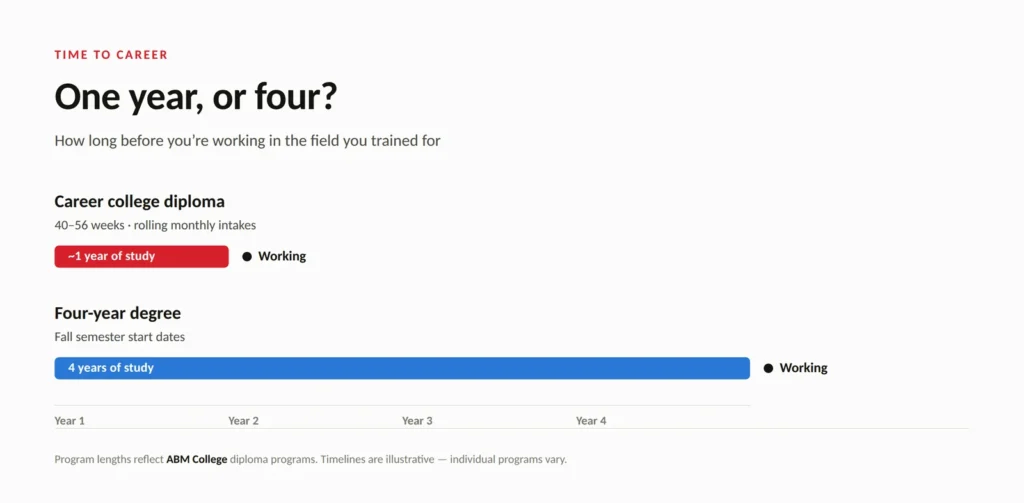
Here’s the math that matters most.
A bachelor’s degree takes four years. A career college diploma at ABM College takes 40 to 56 weeks — about a year or less from your first class to graduation. And because ABM College uses rolling monthly intakes instead of semester start dates, you can typically begin within weeks of applying rather than waiting until September.
That time difference is money. Every year you spend in school instead of the workforce is a year of salary you don’t earn. Graduating three years sooner means three years of income, experience, and career progression that a degree-holder spends in a lecture hall.
What Career College Graduates Earn
Earnings depend on the field you train for, but the numbers are stronger than many people expect. According to the Government of Canada’s Job Bank, administrative assistants in Canada earn a median wage of $26.44 per hour — roughly $55,000 per year for full-time work — with experienced professionals reaching $36.88 per hour.
Healthcare support roles tell a similar story. Demand for health care aides, medical office assistants, and pharmacy assistants continues to grow as Canada’s population ages. (Curious about a specific field? See our breakdown of how much pharmacy assistants earn in Canada.)
The pattern across fields is consistent: career college graduates enter stable, in-demand occupations with clear wage progression — without the four-year wait or the four-year debt.
Where ABM College Graduates Work
Numbers tell this story better than promises. Since 2011, ABM College has trained more than 15,000 students across its Calgary, Toronto, and Winnipeg campuses and its online diploma programs — including over 2,000 students enrolled in its licensed programs in the 2024–25 reporting year alone. And the job outcomes are independently verified: ABM College reports graduation and job placement rates for every licensed program to Alberta Advanced Education each year. Here’s how some of the most popular programs performed in 2024–25:
| Program | Graduation Rate | Job Placement Rate |
| Education Assistant | 92.1% | 75.6% |
| Pharmacy Assistant | 88.5% | 70.8% |
| Medical Office Assistant & Unit Clerk | 88.5% | 71.4% |
| Digital Marketing | 85.7% | 80.0% |
| Business Administration | 75.4% | 80.8% |
| Administrative Assistant | 76.9% | 77.3% |
Source: ABM College Institution Annual Report 2024–25, Alberta Advanced Education.
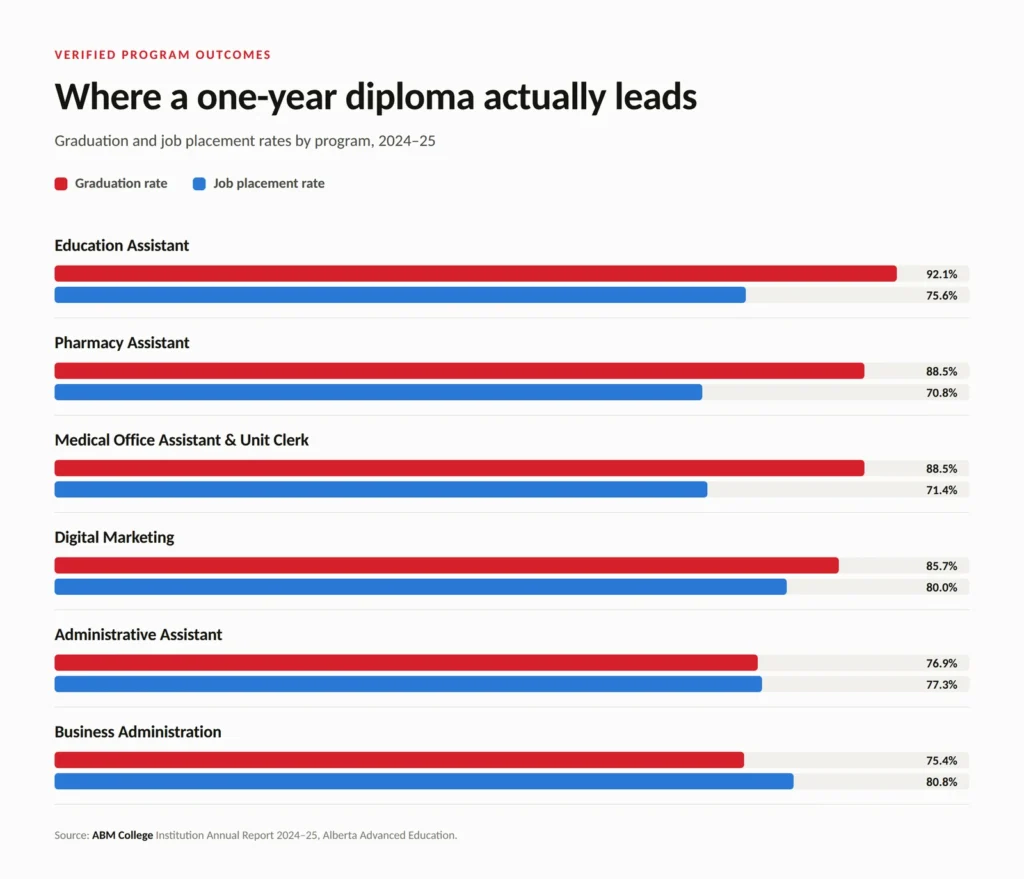
And where do those graduates actually land? ABM College’s practicum and employer network includes names Canadians recognize: the Calgary Board of Education, Calgary Catholic School Division, and Edmonton Public Schools for education assistants; Shoppers Drug Mart, Rexall, and Costco Wholesale Pharmacy for pharmacy assistants; medical clinics across Alberta for medical office assistants; CBI Health and the Winnipeg Regional Health Authority in healthcare support; and tech employers like CGI and SysGen Solutions Group for network administration graduates. Legal assistant students have completed placements with law firms and even the Court of King’s Bench of Alberta.
Practicums and work placements are built into ABM College programs, which means many students meet their first employer before they graduate.
Do Employers Recognize Career College Diplomas?
In skills-based fields, generally yes. Diplomas from provincially licensed career colleges are widely recognized by Canadian employers, and in areas like healthcare support, office administration, and technology, hiring managers tend to care more about whether you can do the job on day one than where you studied.
Do career college graduates have the same opportunities as university graduates? In their trained field, they compete well — and often arrive with a practical edge, because practicum experience and current, industry-specific training are exactly what these roles ask for. The employer list above reflects this: school boards, national pharmacy chains, health authorities, and IT firms take on career college students and graduates every year. Where a university degree still matters is in professions that legally require one (teaching, engineering, law). For the in-demand support and technical careers career colleges serve, a diploma is a credential employers know and hire.
The Cost Side of the Equation
Tuition varies by program, so the honest way to weigh cost is against what the diploma returns: how soon you’re working, and in what field. Because programs run about a year, the real financial question isn’t just the tuition bill — it’s how quickly you’re back to earning full-time, in a career with room to grow.
You don’t have to fund it alone, either. Eligible ABM College students can use government student loans and grants, and newcomers to Canada can explore low-interest financing through Windmill Microlending. Learn more on our financial aid page — an admissions advisor can walk you through program-specific costs and funding options before you commit to anything.
5 Signs a Career College Is Worth It for You
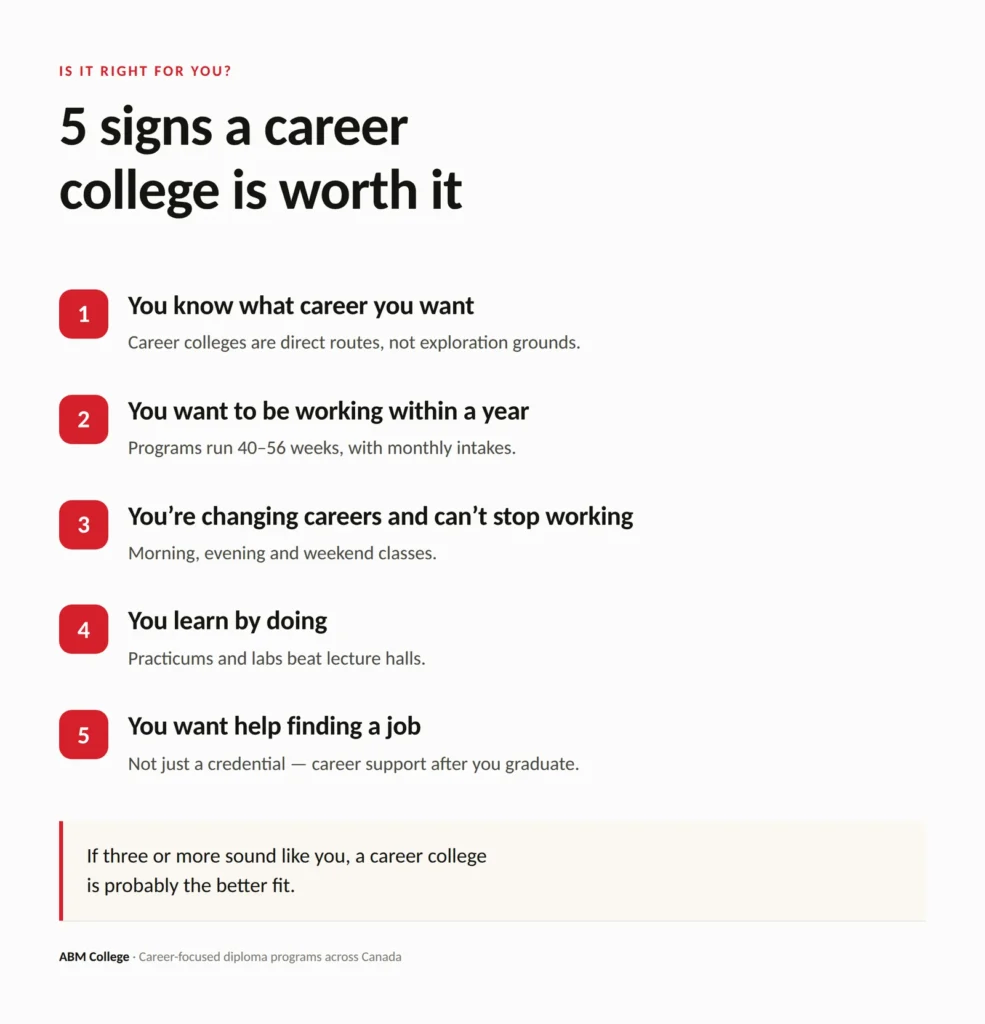
- You know what career you want. Career colleges are direct routes, not exploration grounds. If you’ve picked your destination, a diploma is the express lane.
- You want to be working within a year. With 40–56 week programs and monthly intakes, the timeline is measured in months, not years.
- You’re changing careers and can’t stop working. Online evening, morning, and weekend classes let you keep your current job while you train for the next one.
- You learn by doing. Practicums, labs, and instructor-led classes beat lecture halls if hands-on is how you learn best.
- You want support finding a job, not just a credential. Look for colleges with free career counselling — resume help, interview prep, and employer connections — that continues after graduation.
If three or more of those sound like you, a career college isn’t just worth it — it’s probably the better fit.
How ABM College Makes the Diploma Pay Off
As a career college in Canada since 2011, ABM College builds every program around employability: instructors with real industry experience, practicums that put your skills to work before you graduate, flexible online diploma programs in healthcare, business, and technology, and free career counselling that stays free after you graduate — whether you study online from anywhere in Canada or in person in Calgary, Winnipeg or Toronto.
Frequently Asked Questions
Are career college diplomas recognized by employers in Canada? In skills-based fields, generally yes. Diplomas from provincially licensed career colleges are widely recognized by Canadian employers, particularly in healthcare support, office administration, accounting, and technology, where practical training and practicum experience carry significant weight in hiring.
How long does a career college diploma take in Canada? Most career college diploma programs take between 40 and 56 weeks — about a year or less. At ABM College, rolling monthly admissions mean you can usually start within weeks of applying instead of waiting for a fall semester.
Is a career college cheaper than university in Canada? Costs vary by program and institution, so compare specific programs rather than averages. The clearer financial difference is time: a career college diploma takes about a year, so you return to full-time earning roughly three years sooner than a degree path. Government student loans, grants, and newcomer financing options like Windmill Microlending can help cover tuition.
What percentage of career college graduates find jobs? It varies by program, and reputable career colleges publish their numbers. In ABM College’s 2024–25 report to Alberta Advanced Education, job placement rates for popular programs included Business Administration at 80.8%, Digital Marketing at 80%, Administrative Assistant at 77.3%, and Education Assistant at 75.6% — figures verified by the provincial regulator.
Can I attend a career college while working full-time? Yes. Many ABM College students keep working full-time while they study. Morning, evening, and weekend class blocks — delivered through live online classes — are designed to fit around work and family commitments.
So — Are Career Colleges Worth It?
Not for everyone, and that’s worth saying plainly. If the career you want legally requires a degree, or you want four years of broad academic exploration, university is the right road — no diploma substitutes for it.
But if you’re the other kind of person — the one who already knows where they’re headed and mostly needs the shortest credible route there — then everything in this article points the same way. A year of focused training. A practicum where employers like school boards, pharmacy chains, and health authorities see your work before your resume. Graduation and placement rates you can verify with the provincial regulator instead of taking on faith.
A year from now, you’ll be a year older either way. The question is whether that year ends with you doing the work you trained for. Explore ABM College’s online diploma programs in healthcare, business, and technology, or talk to an admissions advisor about the program that fits where you’re headed — and make the decision with the numbers in front of you. They’re the same ones we show the government.

About The Author

Kiran Vijay leads SEO at ABM College, working alongside admissions advisors and program teams across the Calgary, Winnipeg, and Toronto campuses. With 10+ years in SEO, paid search, and content strategy for Canadian post-secondary education, Kiran writes about diploma programs, career outcomes, and the job market for career college graduates — grounded in ABM College’s own enrolment and graduate employment data reported to Alberta Advanced Education. Connect on LinkedIn.