
Posted on November 5, 2026 in
Health
The short answer: in 2027, digital marketing looks less like a list of channels and more like a set of habits. AI does more of the first draft. Search tools increasingly answer questions directly. Privacy shapes what data you can use. Measurement decides what keeps its budget. The tools will keep changing. The skills underneath them change more slowly: strategy, analysis, clear writing and judgment. Below are six trends we think matter, what each means for the work, and how to tell whether a digital marketing course is the right way to build the skills.
If you’re reading this, you’re probably asking two questions. Which of these trends are worth my time? And will learning this still pay off when the tools keep changing?
One note on what this is. These are our views on where the work is heading, based on what marketers are already doing. They aren’t forecasts, and we haven’t attached numbers to them.
What are the biggest digital marketing trends for 2027?
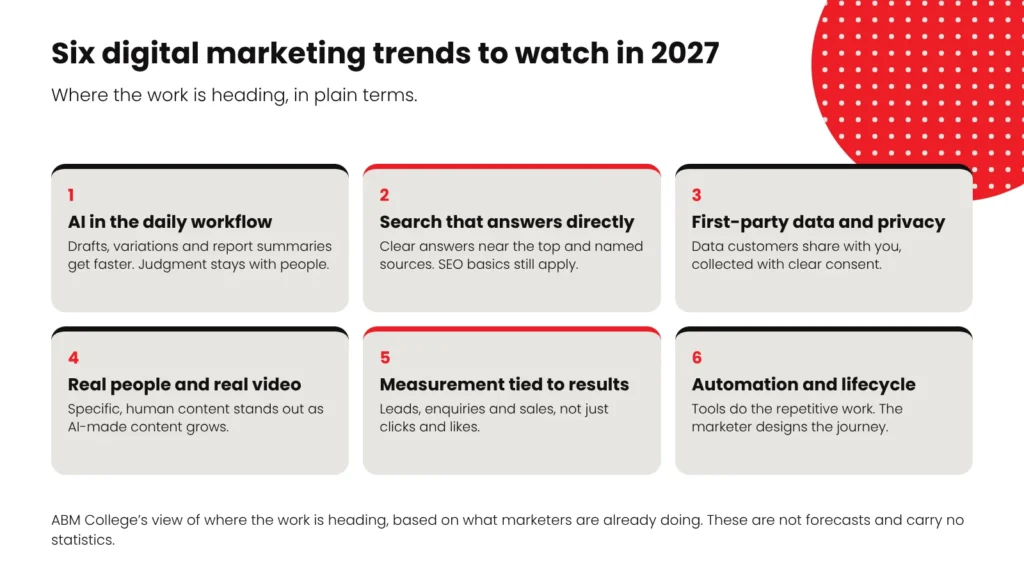
1. AI becomes part of the daily workflow
Drafting, ad and email variations, report summaries, data tidying: this is where AI already saves time. The blank page stops being the hard part.
Everything published still needs a person who knows the audience, the brand and the rules. First drafts get cheaper. Judgment doesn’t. We cover the bigger “will AI replace marketers?” question in Digital Marketing vs AI, so we won’t repeat it here.
2. Search answers questions directly
Search tools increasingly summarize an answer on the results page. Content that states a clear answer near the top, names its sources and is easy to quote has a better chance of being used.
That doesn’t retire classic SEO. Structure, relevance and a fast, clear site are still the base. If you’re curious about the role, see what an SEO specialist does.
3. First-party data and privacy
More teams are leaning on data that customers share with them directly, such as email sign-ups, accounts and surveys, and less on data rented from platforms. Clear consent isn’t optional. Privacy rules and customer expectations both shape what a marketer can collect and use, so knowing them is part of the job.
4. Real people and real video
As AI-made content becomes common, content that’s specific, human and a little imperfect stands out. Short video, real customers and people who actually did the thing tend to earn more trust than polished generic copy.
5. Measurement tied to business results
Clicks and likes are easy to count. Leads, enquiries, sales and returning customers are what a business pays for. Marketers who can connect a campaign to a result, and say what they would change, are easier to trust with budget.
6. Automation and lifecycle marketing
Email sequences, triggers and customer-relationship tools do the repetitive work. The marketer designs the journey: who gets what, when, and why. Automation makes a good plan faster. It also makes a weak plan fail faster.
How is AI used in digital marketing today?
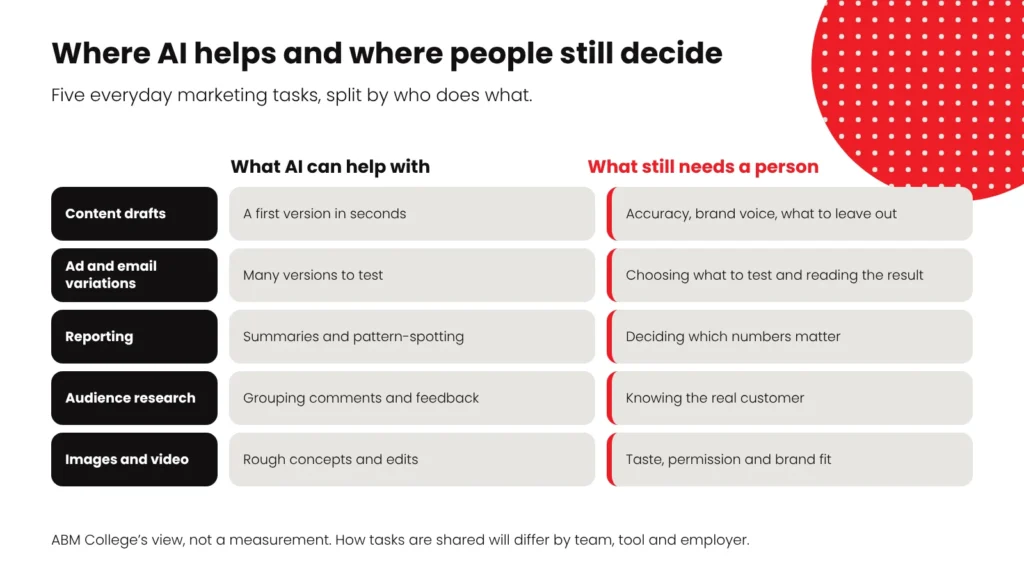
Here is the split between what AI helps with and what still needs a person.
| Task | What AI can help with | What still needs a person |
|---|---|---|
| Content drafts | A first version in seconds | Accuracy, brand voice, what to say and what to leave out |
| Ad and email variations | Many versions to test | Choosing what to test and reading the result |
| Reporting | Summaries and pattern-spotting | Deciding which numbers matter |
| Audience research | Grouping comments and feedback | Knowing the real customer |
| Images and video | Rough concepts and edits | Taste, permission and fit with the brand |
Is digital marketing still a good career for 2027?
Nobody can promise that, and be wary of anyone who does.
What we can point to is public and dated. In the Government of Canada’s National Occupational Classification (2021), digital marketing specialist and social media specialist are listed among the example titles for NOC 11202, professional occupations in advertising, marketing and public relations. That page says a university degree or college diploma in marketing or a related field is usually required. We’re saying that plainly because it’s what the standard says, and you should weigh it. “SEO specialist” isn’t in that unit group’s example list, so check how employers title the job you want.
Job Bank lists wages for digital marketing specialists (NOC 11202) in Canada from $20.50 to $57.44 an hour, with a median of $35.58 (2023–2024 data, updated November 2025). That range covers every level and every province. It’s not a prediction for a new graduate.
For the current outlook where you live, check Job Bank’s outlook for your province. For what the job looks like day to day, see our digital marketing career guide. Then read ten job postings in your city. Count how many ask for a portfolio, which tools they name and which skills repeat.
Which digital marketing skills are worth learning first for 2027?
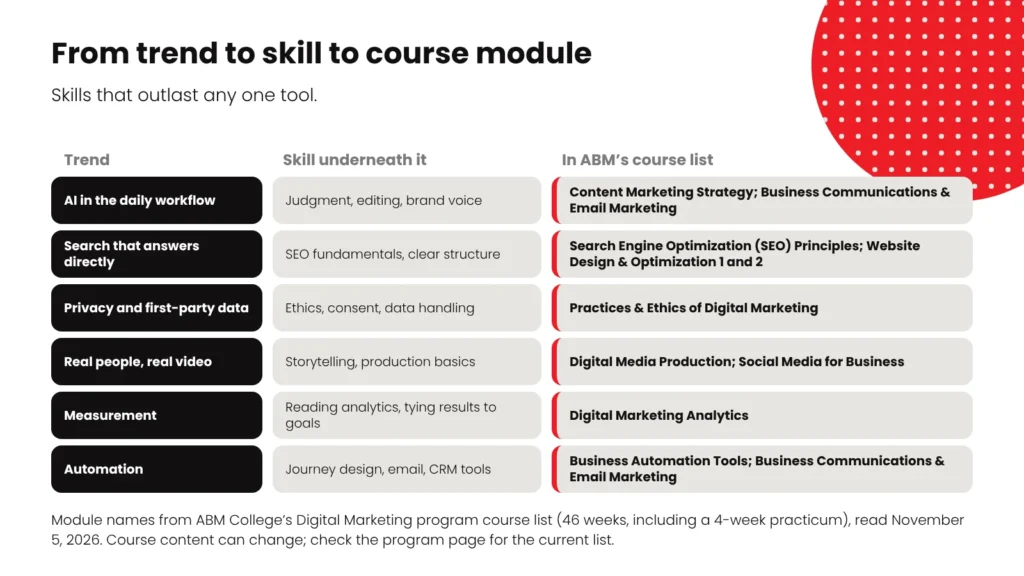
Start with the skills that don’t expire when a tool does.
| Trend | Skill underneath it | Where it shows up in ABM’s course list |
|---|---|---|
| AI in daily work | Judgment, editing, brand voice | Content Marketing Strategy; Business Communications & Email Marketing |
| Search that answers directly | SEO fundamentals, clear structure | Search Engine Optimization (SEO) Principles; Website Design & Optimization 1 and 2 |
| Privacy and first-party data | Ethics, consent, data handling | Practices & Ethics of Digital Marketing |
| Real people, real video | Storytelling, production basics | Digital Media Production; Social Media for Business |
| Measurement | Reading analytics, connecting results to goals | Digital Marketing Analytics |
| Automation | Journey design, email, CRM tools | Business Automation Tools; Business Communications & Email Marketing |
ABM College’s digital marketing course runs 46 weeks, including a 4-week practicum, and its modules cover the foundations that AI tools sit on top of. Admissions can confirm start dates and formats for your campus or province.
Is a digital marketing course right for you?
It’s not for everyone, and that’s worth saying plainly.
It may suit you if:
- You’re changing fields and want a structured path rather than piecing it together from videos.
- You like both the creative side (writing, video, design) and the numbers side (analytics, testing).
- You’d rather build a portfolio of real work, including a practicum, than collect tool badges.
- You want to learn the basics properly before you start working with AI tools.
It may not be the right fit yet if:
- The role you want lists a university degree as a requirement. Check postings first.
- You already work in marketing and need one specific tool. A short, targeted course will serve you better.
- You need a guarantee of a job at the end. No program can give one, and we won’t pretend otherwise.
The Bottom Line
The tools will look different in 2027, and different again in 2028. So don’t ask which tool to learn. Ask whether you can explain why a campaign worked, and what you would change next time. That skill carries from one tool to the next.
If that sounds like the work you want, start with the digital marketing course page and read the full course list. If you’re in Calgary, see the Calgary campus page. If you’re still deciding, read the career guide and 10 branches of digital marketing first.
Sources: Government of Canada, National Occupational Classification 2021, unit group 11202 (Employment and Social Development Canada), read November 5, 2026. Job Bank wage figures for NOC 11202 (2023–2024 data, updated November 2025) as published on ABM College’s Digital Marketing program page; Job Bank was not re-checked for this draft.
Frequently Asked Questions
What are the digital marketing trends for 2027? We see six that matter: AI in the daily workflow, search tools that answer questions directly, first-party data and privacy, real people and real video, measurement tied to business results, and automation. These are our views on where the work is heading, not forecasts with numbers.
How will AI change digital marketing in 2027? AI is likely to take on more first drafts, content variations and report summaries. People are still needed to judge accuracy, brand fit and what the results mean. Nobody can say exactly how any job will change.
Will AI replace digital marketers? AI changes tasks more than it removes the need for people who can judge what’s working, but nobody can promise how any job will change. Our fuller view is in Digital Marketing vs AI.
Is digital marketing still a good career? It depends on your skills, your location and the job you want. Canada’s occupational standard says a university degree or college diploma in marketing or a related field is usually required for professional roles in this group. Check Job Bank’s outlook for your province and read current job postings before you decide.
What digital marketing skills should I learn first? Start with skills that outlast tools: strategy, clear writing, SEO fundamentals, analytics, ethics and data handling, and how to design an email or automation journey.
How long is ABM College’s digital marketing course? 46 weeks in total, including a 4-week practicum. Contact Admissions to confirm start dates and formats.
About The Author

Kiran Vijay leads SEO at ABM College, working alongside admissions advisors and program teams across the Calgary, Winnipeg, and Toronto campuses. With 10+ years in SEO, paid search, and content strategy for Canadian post-secondary education, Kiran writes about diploma programs, career outcomes, and the job market for career college graduates — grounded in ABM College’s own enrolment and graduate employment data reported to Alberta Advanced Education. Connect on LinkedIn.