
Posted on August 5, 2026 in
Business
Job postings will tell you the duties. What they won’t tell you is what the work feels like at four o’clock on a cutoff day, when payroll closes at five and three timesheets still haven’t come in.
The short answer: an accounting and payroll administrator runs two sets of books against two sets of deadlines. On the accounting side — recording transactions, processing invoices and payments, reconciling accounts, helping close the month. On the payroll side — collecting hours, calculating pay and deductions, running the pay cycle, remitting to the Canada Revenue Agency, and producing T4s and Records of Employment. In Canada the work maps onto two National Occupational Classification codes: NOC 12200 (accounting technicians and bookkeepers) and NOC 13102 (payroll administrators).
The longer answer is the useful one, because the title reads like one job and it is usually two. If you’re weighing whether to train for this — through payroll courses online or any other route — the thing worth understanding first isn’t the task list. It’s the rhythm.
Two jobs, one title
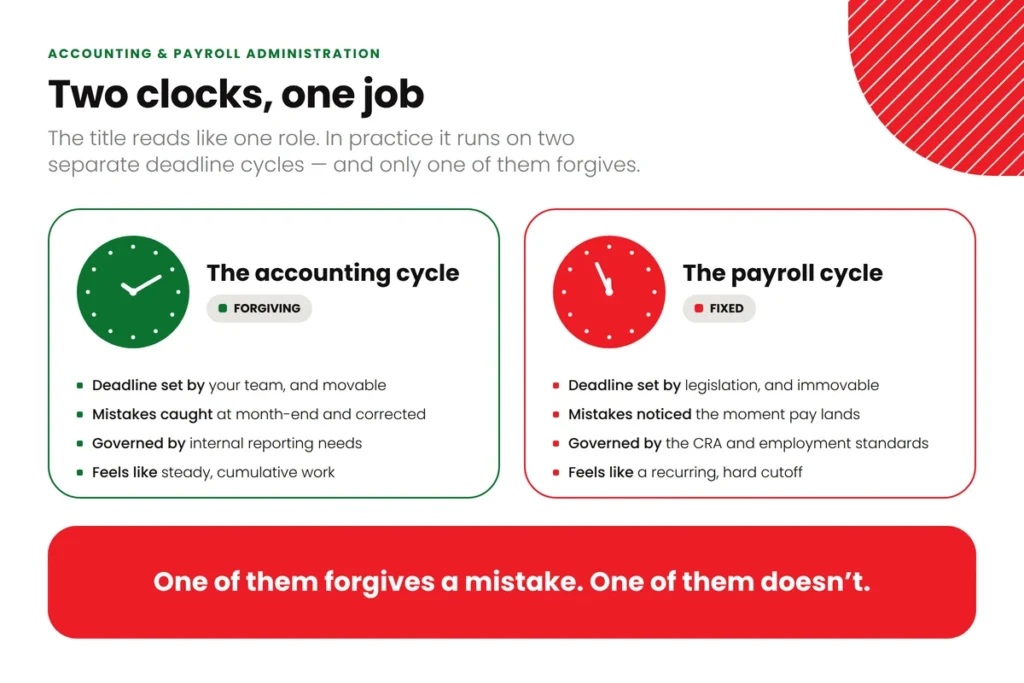
Accounting work is cyclical and mostly forgiving. An invoice coded to the wrong account in week one gets caught at month-end and fixed. The ledger tolerates correction.
Payroll is not like that. Payroll has a date, the date is fixed, and the consequence of missing it is that people don’t get paid. Deductions are set by legislation, not preference. Remittance schedules come from the CRA. Nobody in the organization cares how busy your week was.
So the same person spends part of the week in work that can be revisited, and part of the week in work that cannot. How much of each depends almost entirely on the size of your employer:
- At a small business — a contractor, a clinic, a restaurant group — you are likely the whole finance function. Payables, receivables, bank reconciliations, payroll for twelve people, and the year-end file for the external accountant. Wide, varied, and you own all of it.
- At a mid-sized company, you’re one of two or three people, and the split usually falls along accounting-versus-payroll lines rather than by task.
- At a large employer or a payroll service bureau, you specialize. You might do payroll only, for several hundred employees, and never touch a general ledger.
All three get advertised under similar titles. They are genuinely different jobs. It’s worth asking in an interview which one you’re applying for — and it’s the main reason people who liked the role at one employer sometimes dislike it at the next.
If the accounting half is what draws you, the accounting assistant role explained covers a narrower version of the same work.
A Thursday on the pay cycle
Take a semi-monthly payroll at a mid-sized Canadian employer, with cutoff at 5:00 p.m. Thursday and pay landing the following Wednesday.
8:30 a.m. Email first, because that’s where the exceptions live. A new hire’s TD1 forms have come in. A manager wants to know why an employee’s overtime looked short last period. Someone in the field has submitted a timesheet as a photograph of a handwritten page.
9:00 a.m. Timesheet review. Not entering hours — checking them. Overtime that crosses a threshold, statutory holiday pay, shift premiums, a vacation day taken but not recorded. This is where most payroll errors are caught or created, and it is slower and more interesting than it sounds, because you’re reconciling what the schedule said against what people actually did.
10:30 a.m. Switch hats. Bank reconciliation for the previous month, a stack of supplier invoices to code and enter in Sage 50, two expense claims missing receipts.
1:00 p.m. Back to payroll. Chase the three outstanding timesheets — by email, then by phone, then by asking their supervisor. This is a real and recurring part of the job that appears in no job description anywhere.
3:00 p.m. Process. Enter the hours, apply the deductions, run the register. Then check the register — gross-to-net on a sample of employees, a comparison against last period to catch anything that moved without reason. A $4,000 line where a $400 line should be is obvious if you look and invisible if you don’t.
4:45 p.m. Cutoff. Submit for approval.
5:15 p.m. The last timesheet arrives. Whether that becomes an off-cycle adjustment or waits for next period is a judgment call, and you’ll make it a dozen times a year.
Not every day looks like that. Days off the cycle are quieter and lean toward the accounting side. But this is the day the job is organized around.
The calendar that actually runs the job
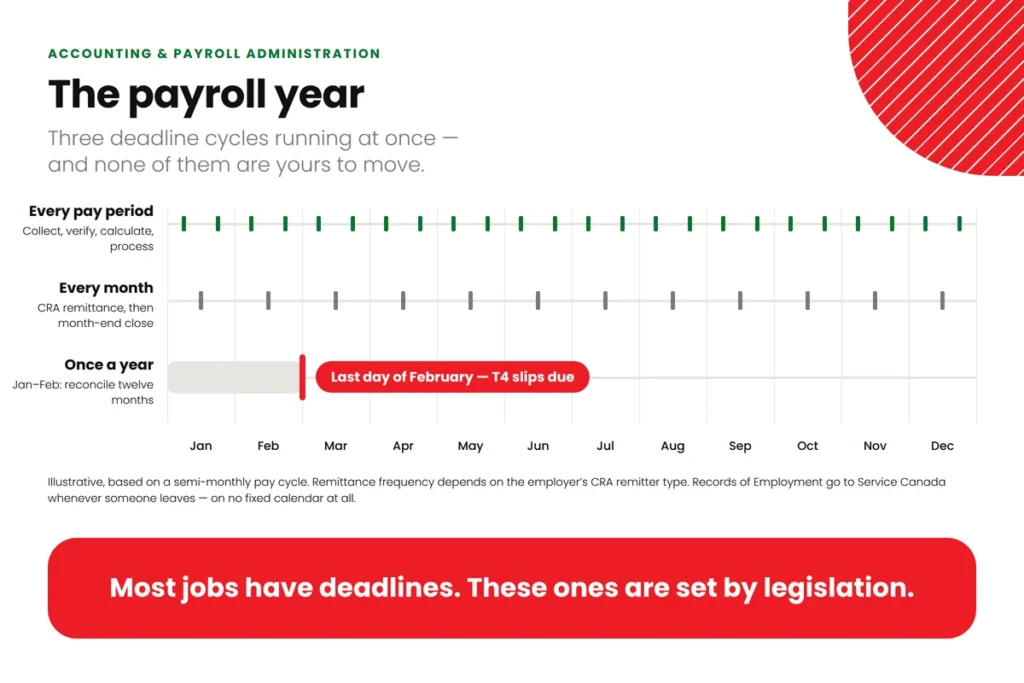
Most roles have deadlines. This one has a nested set of them, and they’re mostly not yours to move.
Every pay period. Collect, verify, calculate, process, approve, transmit. Weekly, bi-weekly, or semi-monthly depending on the employer — and the shorter the cycle, the more of your month it occupies.
Monthly. Remit source deductions to the CRA on the schedule set by your employer’s remitter type. Reconcile the payroll clearing accounts to the general ledger. Then month-end close on the accounting side: accruals, journal entries, and the reconciliations that make the numbers defensible.
Annually. Year-end is the busy season. T4 slips are due to employees and to the CRA by the last day of February, which means January and February are spent reconciling twelve months of payroll against the ledger and finding the one discrepancy from August that nobody noticed at the time.
Whenever someone leaves. A Record of Employment goes to Service Canada. It’s a small task with real consequences, because it’s what a former employee’s Employment Insurance claim is assessed against.
That last one is the character of the whole job in miniature: administrative on the surface, and directly attached to someone’s ability to pay rent.
What the job posting leaves out
Four things worth knowing before you commit a year to training for this.
You will know what everyone earns. Including your manager, including the person at the next desk who assumes you don’t. Discretion isn’t a soft skill in payroll; it’s a condition of doing the job at all, and some people find it genuinely uncomfortable.
Your mistakes are visible and personal. A misposted journal entry is an accounting problem. A payroll error is a person opening their pay statement and finding it wrong. Most people in the role describe this as the part they had to get used to.
A lot of the work is chasing other people. Timesheets, receipts, approvals, banking details, signed forms. If unanswered requests bother you, this will bother you regularly.
Nobody notices when it goes right. A payroll that ran correctly generates no feedback at all. The satisfaction has to come from the thing balancing, not from anyone remarking on it.
None of that is a reason to avoid the field. It’s the reason to know whether it fits before you pay for training.
What you actually need to be good at
Two software systems, mainly. In Canadian small and mid-sized business, that’s overwhelmingly Sage 50 and QuickBooks. Job postings name them constantly. Genuine competence in both is a practical hiring advantage, and it’s learnable.
Excel past the basics. Lookups, pivot tables, and enough comfort to reconcile two lists that should match and don’t.
Reading legislation without panic. You don’t need to memorise the Income Tax Act. You need to be able to find the current rule, apply it, and notice when something has changed — because the rules change annually and last year’s answer is sometimes this year’s error.
Precision you can sustain. Not perfectionism. The ability to do a careful thing correctly for the four-hundredth time, on a Thursday afternoon, at the same standard as the first.
Would you like this job? An honest filter
This role suits you if:
- You get real satisfaction from things reconciling — the kind of person for whom a balanced account is its own reward
- You’d rather have a clear right answer than an interesting ambiguity
- You want work with a visible rhythm and defined completion points, not open-ended projects
- You’re discreet by temperament
- You want to be genuinely useful to an organization without needing to be its centre of attention
It probably doesn’t suit you if:
- Fixed, non-negotiable deadlines are a source of dread rather than structure
- You want variety in the substance of the work, not just in the exceptions
- Repetitive precision drains you rather than settling you
- You’d find it hard to hold salary information without it affecting how you feel at work
Be honest on the second list. It’s cheaper to rule this out now than eleven months into a program. For the market side of the question rather than the fit side, we’ve covered the outlook for accounting jobs in Canada separately.
What does it pay?
We’re not going to quote you a single number, because for this role an average is close to useless — the range across a twelve-person clinic and a payroll bureau processing thousands of employees is enormous, and it varies by province and by experience.
Here’s how to get a real answer instead. Go to the Government of Canada Job Bank and look up NOC 13102 for payroll administrators and NOC 12200 for accounting technicians and bookkeepers. Filter to your own province or city. That gives you low, median and high wages for where you’d actually be working, from the federal source, updated on a published schedule. Then cross-check it against live postings on Indeed or Job Bank for the same title in your area.
Do that for twenty minutes and you’ll know more about your local market than any national average could tell you.
Where the role leads
The role is a common entry point rather than a ceiling. Depending on which half you gravitate toward, people move into payroll specialist and payroll supervisor positions, or toward accounting technician, senior bookkeeper, and accounts payable or receivable lead roles. Some move into office or business management, having become the person who understands how the money actually moves.
Our breakdown of career paths in accounting and payroll goes into these in more detail.
How do you become an accounting and payroll administrator in Canada?
There’s no single licensed route. In practice, employers hiring for these roles are usually looking for some combination of a post-secondary credential in accounting or payroll, demonstrated software competence, and — for payroll specifically — progress toward a recognised designation.
Where the PCP designation fits. The National Payroll Institute awards the Payroll Compliance Professional (PCP) designation, and it’s the credential most often named in Canadian payroll postings. Its stated requirement is precise, so it’s worth quoting: “PCP designation requires three core payroll courses, one transfer of credit and one year of related Canadian work experience.” The three core courses are Payroll Compliance Legislation, Payroll Fundamentals 1, and Payroll Fundamentals 2. Requirements must be completed within five years, and you need to be an Institute member to earn and hold the designation.
Read that carefully, because it’s commonly misdescribed. No college program can give you the PCP. Coursework is one of three components — the work experience and the transfer of credit are yours to complete afterward. If a provider implies you’ll graduate holding the designation, that’s a reason to ask harder questions.
What a program can do is cover the coursework component. ABM College’s Accounting and Payroll Administration Diploma includes all three core payroll courses alongside financial and managerial accounting, income taxation, financial planning, and hands-on work in Sage 50 and QuickBooks. It runs 55 weeks online, in morning, evening, or weekend class blocks, and ends with a four-week practicum and a career-preparation course.
For that program, ABM College reported an 81.36% graduation rate and a 71.93% graduate employment rate to Alberta Advanced Education for the 2024–25 reporting year (Institution Annual Report, PAPRS432, April 2024 – March 2025). Those figures describe one program at one campus in one year and are not a prediction about any individual student — rates move year to year, so ask any college you’re considering for its most recent numbers and the number of graduates behind them. Career-services support is exactly that: support with the job search, not a job.
If you’re earlier in the decision than this, how to start your accounting career in Canada is the better starting point.
Three questions to ask before you enrol anywhere
“Which payroll courses does this cover, and do they satisfy the National Payroll Institute’s core requirement?” Ask for the course names. Compare them against the Institute’s own published list. Vagueness here is informative.
“Which software will I actually use, and for how many hours?” Sage 50 and QuickBooks appear in the job postings you’ll be answering. A module that mentions them is not the same as time spent working in them.
“What are your graduation and employment rates for this specific program, and how many graduates is that based on?” Any college reporting to a provincial regulator can answer this. A percentage with no denominator behind it tells you very little.
Those questions work on us as well as on anyone else. That’s the point of them.
The honest version
The job is two jobs. One of them forgives mistakes and one of them doesn’t, and the second one is attached to whether people can pay their rent on time. That’s the whole character of the work.
Which means the question isn’t really whether accounting and payroll administration is a good career. It’s whether you’re the kind of person who finds a fixed deadline steadying or suffocating — because everything else about the role, the software, the legislation, the reconciliations, is learnable in about a year. Temperament isn’t.
If you read the Thursday above and recognised something you’d be good at, this is a field worth looking into properly. Every organization with employees has to run payroll, and most have to keep books — that isn’t a promise about your job search, it’s just why this work exists nearly everywhere, in every sector, in every city in the country.
And if you read it and felt your shoulders rise: that was useful information too, and it cost you nothing.
Look up NOC 13102 on Job Bank for your city. Compare the Accounting and Payroll Administration Diploma curriculum against the National Payroll Institute’s core course list. Then decide with the details in front of you, not the job title.
FAQ
What does an accounting and payroll administrator do? An accounting and payroll administrator handles both bookkeeping and payroll for an employer. On the accounting side that means recording transactions, processing invoices and payments, reconciling accounts, and supporting month-end and year-end close. On the payroll side it means collecting and verifying hours, calculating pay and statutory deductions, processing the pay cycle, remitting source deductions to the Canada Revenue Agency, and producing T4 slips and Records of Employment. In Canada the work spans two National Occupational Classification codes: NOC 12200 (accounting technicians and bookkeepers) and NOC 13102 (payroll administrators).
Is accounting and payroll administration a stressful job? It depends on what you find stressful. Payroll deadlines are fixed and set by legislation rather than by your employer, so the work has hard, recurring cutoffs — pay dates, CRA remittance schedules, and T4 slips due by the last day of February. People who find defined deadlines steadying tend to like the role. People who find non-negotiable deadlines draining often don’t. The accounting side of the job is generally more flexible than the payroll side.
What software do accounting and payroll administrators use in Canada? Sage 50 and QuickBooks are the two systems named most often in Canadian job postings for these roles, particularly in small and mid-sized businesses. Strong Excel skills — lookups, pivot tables, and reconciling data sets — are also widely expected. Larger employers may use enterprise payroll platforms instead, so check individual postings in your area.
How do you become an accounting and payroll administrator in Canada? There’s no single licensed route. Employers typically look for a post-secondary credential in accounting or payroll, demonstrated competence in accounting software, and for payroll roles, progress toward the Payroll Compliance Professional (PCP) designation from the National Payroll Institute. Diploma programs that include the three core payroll courses — Payroll Compliance Legislation, Payroll Fundamentals 1, and Payroll Fundamentals 2 — cover the coursework component of that designation.
Does a diploma give you the PCP designation? No. The National Payroll Institute states that the PCP designation requires three core payroll courses, one transfer of credit, and one year of related Canadian work experience, all completed within five years, plus Institute membership. A college program can deliver the coursework component. The transfer of credit and the work experience are completed separately, and no program can award the designation on a graduate’s behalf.
What’s the difference between an accounting and payroll administrator and a bookkeeper? The roles overlap considerably. A bookkeeper generally focuses on recording and reconciling financial transactions. An accounting and payroll administrator does that work and also runs payroll — calculating deductions, meeting CRA remittance deadlines, and handling year-end payroll reporting. At small employers the two titles often describe the same person; at larger ones they’re separate positions.
About The Author

Kiran Vijay leads SEO at ABM College, working alongside admissions advisors and program teams across the Calgary, Winnipeg, and Toronto campuses. With 10+ years in SEO, paid search, and content strategy for Canadian post-secondary education, Kiran writes about diploma programs, career outcomes, and the job market for career college graduates — grounded in ABM College’s own enrolment and graduate employment data reported to Alberta Advanced Education. Connect on LinkedIn.