
Posted on July 31, 2026 in
Technology
You’ve decided you want into cyber security. The harder part is deciding how — and the options refuse to line up. One route says you’ll be working in twelve weeks. Another takes eighteen months. They cost different amounts, they assume different things about you, and whoever is selling each one has no particular reason to tell you which fits your situation.
Strip away the marketing and most people are choosing between two things: a stack of industry certifications, or a diploma program. Both are legitimate routes into the field in Canada. They suit different people, take different amounts of time, and fail in different ways. ABM College delivers its version as cyber security training online across 70 weeks — but whether that shape suits you depends almost entirely on where you’re starting from, which is what this guide is about.
What you’re actually choosing between
Certifications are exams. You study — self-paced, from a book, a video course, or a bootcamp — then sit a test. CompTIA Security+ is the best known. Passing proves you know a defined body of material.
A diploma is a structured program: instructors, a set curriculum, deadlines, graded work, and usually a practicum. ABM College’s runs 70 weeks and ends with five weeks in a real workplace.
The difference that matters isn’t prestige. It’s this: a certification proves you know things. A diploma is built to make you able to do things, and gives you somewhere to prove it. Which you need depends on whether you already have hands-on IT experience.
Four routes people actually take
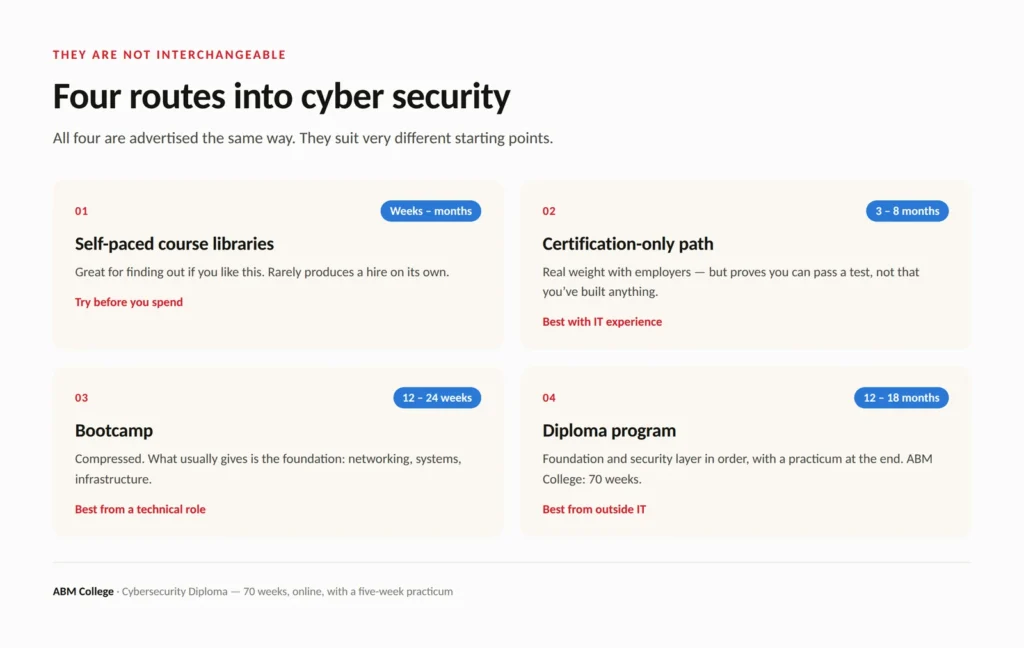
They get advertised interchangeably. They are not interchangeable.
Self-paced course libraries (Udemy, Coursera, YouTube). Weeks to months, cheap or free, and genuinely useful — for finding out whether you like this. What they rarely produce on their own is a hire: no structure, no accountability, nobody checking your work, nothing an employer can verify. Best used before you spend real money, to learn whether packet captures bore you or fascinate you.
Certification-only paths. Two to six months per certification if you’re disciplined. Certifications are widely recognized by Canadian employers — but a certificate shows you can pass a test, not that you’ve ever built anything. People who succeed this way usually have IT experience already; the certification formalizes what they can do.
Bootcamps. Twelve to twenty-four weeks, intense, cohort-based. Good ones are genuinely good. The catch is compression — something has to give, and what usually gives is the foundation: networking, operating systems, infrastructure. Bootcamps tend to work best for switchers coming from adjacent technical roles. For complete beginners, the common failure mode isn’t dropping out — it’s finishing and finding that many postings still ask for hands-on experience you haven’t had a chance to build yet.
Diploma programs. Roughly a year to eighteen months. Slower, and that’s the design — the IT foundation and the security layer, in order, with a practicum at the end.
There’s no universally right answer. There’s a right answer for your starting point.
What Canadian employers actually screen for
A handful of certifications come up repeatedly in Canadian job postings, and they stack in a sensible order. You don’t have to take our word for it — spend twenty minutes on Job Bank or a job board filtering for entry-level security roles in your city, and you’ll see the same names recur. Requirements do vary by employer, sector and province, so treat this as a pattern rather than a checklist.
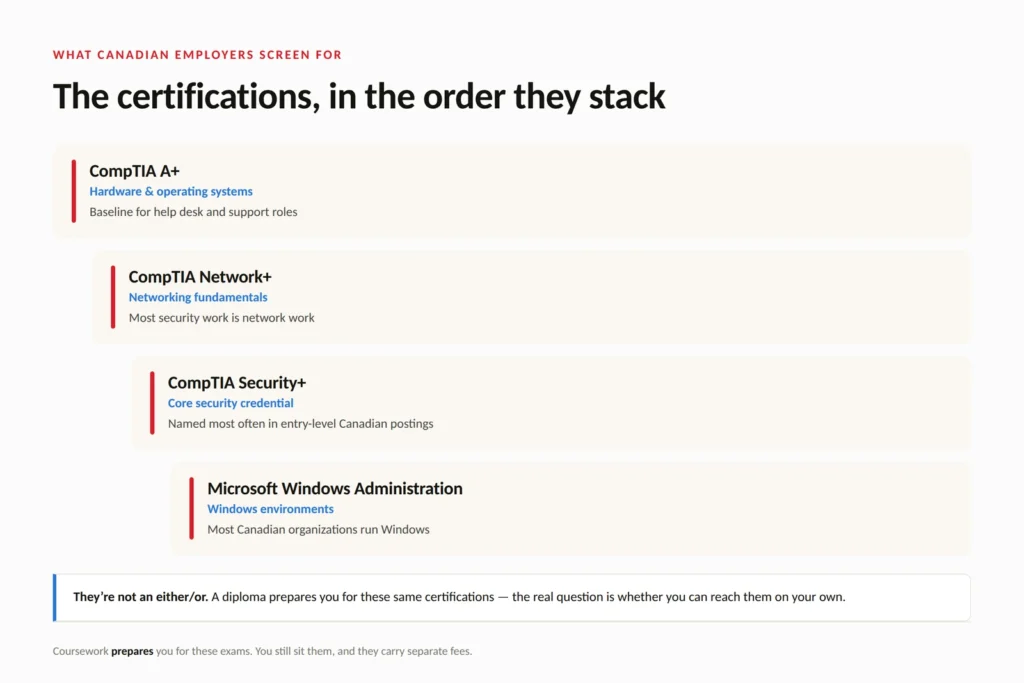
CompTIA A+ — hardware and operating systems. Often listed for help desk and support roles, which are a common entry point into security careers.
CompTIA Network+ — networking fundamentals. A great deal of security work is network work wearing a different hat.
CompTIA Security+ — the security credential you’ll see named most frequently in entry-level Canadian postings, and a common requirement for analyst roles.
Microsoft Windows Administration credentials come up often as well, since Windows environments are widespread in Canadian workplaces and someone has to secure them.
Here’s the part that reframes the whole debate: this isn’t really an either/or. A good diploma is built to prepare you for these same certifications — ABM College’s coursework maps to CompTIA A+, Network+, Security+ and Microsoft Windows Administration. Any program you’re considering should be able to tell you exactly which exams its curriculum covers; if it can’t, that’s worth noting. So the honest question isn’t “certifications or diploma.” It’s whether you can reach those certifications on your own, or whether you need the structure and lab time to get there.
One practical note either way: coursework prepares you for these exams. You still sit them, and they cost money. Ask any provider whether exam fees and retakes are included — the answers vary.
What a diploma adds that a certification doesn’t
Four things, worth naming plainly.
The foundation underneath. Real training is less “hacking” and more building and breaking the things that get hacked — servicing PC hardware and software, configuring Windows client and Windows Server, Linux fundamentals and the command line, standing up Active Directory, building networks on Cisco routers and switches, applying cryptology. Notice how much of that isn’t security in the movie sense. That’s not padding. It’s difficult to defend infrastructure you’ve never built, which is also why the main types of cybersecurity make far more sense once you understand the systems beneath them.
Lab time you don’t have to build yourself. Standing up a domain controller on your own equipment is possible, but most beginners never get there. It’s a large part of why hands-on training matters so much in this field.
A practicum. ABM College’s program ends with five weeks in a real workplace. For a career switcher with no IT history, that placement can be one of the most useful things on the resume — the difference between “studied security” and “worked in it.”
Structure, if you need it. Some people learn fine alone. Many don’t, and it’s better to know which you are before spending a year finding out.
What a diploma costs you is time. Seventy weeks is longer than a bootcamp by design, not by inefficiency.
How long each route really takes
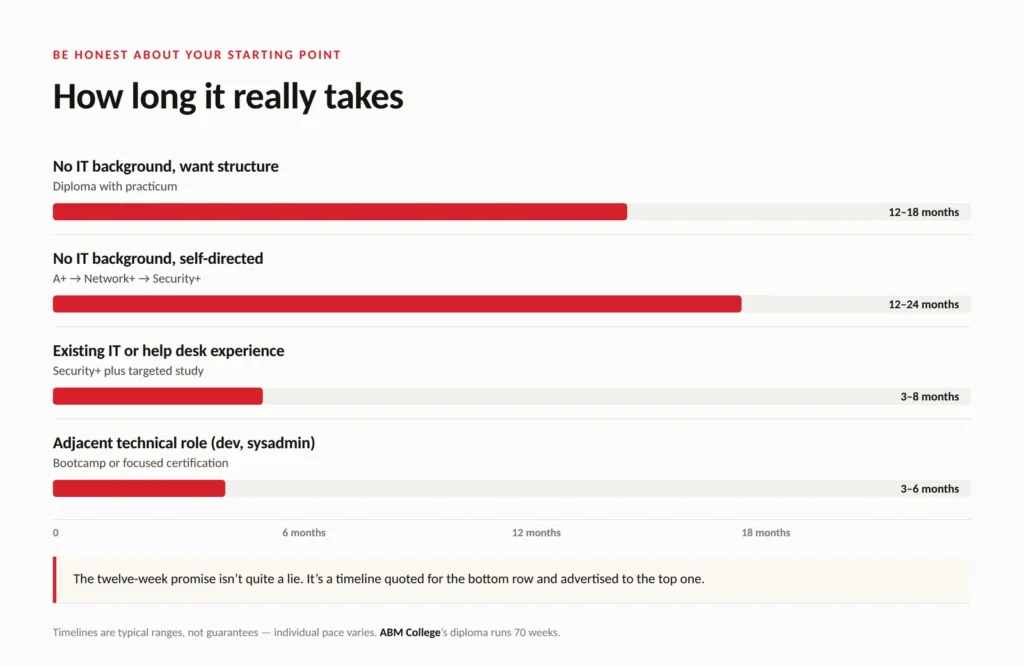
| Your starting point | Route that usually fits | Realistic timeline |
| No IT background, want structure | Diploma with practicum | 12–18 months |
| No IT background, highly self-directed | A+ → Network+ → Security+, self-study | 12–24 months, highly variable |
| Existing IT or help desk experience | Security+ plus targeted study | 3–8 months |
| Adjacent technical role (dev, sysadmin) | Bootcamp or focused certification | 3–6 months |
These are typical ranges reported by learners and providers, not guarantees — individual pace, prior exposure and study hours all move them. What the pattern shows is that the twelve-week promise isn’t quite a lie. It’s a timeline drawn from the bottom row and advertised to the top one.
For reference on the structured route: ABM College’s Cybersecurity diploma runs 70 weeks, is delivered through live instructor-led online classes in morning, evening or weekend blocks, and ends with a five-week practicum. It was the college’s largest program in 2024–25, with a 77.9% graduation rate and a 71.1% job placement rate as reported to Alberta Advanced Education for that year. Rates vary year to year, so ask for the most recent figures — and for the number of graduates behind them.
Is it worth it either way? What the Canadian market looks like
Security roles are hiring across sectors including finance, healthcare, energy and government. Government of Canada Job Bank data for cybersecurity analysts (NOC 21220) puts the national median wage at $49.52 per hour — roughly $103,000 a year at full-time hours — with the reported range running from $30.00 to $72.12 (2023–24 reference period, updated November 2025). Our breakdown of cybersecurity roles and salaries in Canada goes deeper by job title, and Canada’s cybersecurity outlook covers where the growth is concentrated.
The caveat worth stating: that median describes the occupation overall, not your first job. Entry-level security roles are competitive, and plenty of people enter through help desk, support, or network administration before moving into security proper. That’s a normal path, not a detour — and it’s a strong argument for whichever route gives you the IT foundation, because it makes you employable at more than one door.
So which should you pick?
Certifications are likely the better route if you already work in IT, support, or networking; you can hold a study schedule without anyone enforcing it; and you mainly need a credential that formalizes what you can already do. Cheaper, faster, and it fits around a full-time job.
A diploma is likely the better route if you’re starting from outside IT entirely; you want the networking and systems foundation rather than security tooling alone; a practicum on your resume would help; or you already know you learn better with structure and deadlines than alone with a video course.
Neither is right if you haven’t yet checked whether you enjoy the work. Spend twenty dollars and two weekends on a self-paced course first. It’s the cheapest way to avoid an expensive mistake.
Ask these three questions before you enroll anywhere
“What does the first ten weeks cover?” If the answer jumps straight to hacking tools with no networking or operating systems, be careful. Ask what happens if you’ve never touched a server.
“What exactly do I get at the end — and what do I still pay for?” Diploma, certificate of completion, or exam vouchers? Are certification exam fees included? Is the practicum part of the program or an optional extra?
“What are your graduation and job placement rates, and how many graduates is that based on?” Any provider reporting to a provincial regulator can answer this. A percentage without a denominator tells you very little.
The honest version
Cybersecurity is one of the fields where a focused, non-degree route can genuinely lead to a serious career. That part of the pitch holds up.
What’s oversold is the speed — and the framing. The choice was never really certifications versus a diploma, because a good diploma delivers you to the same certifications with the foundation and the lab hours already behind you. The real question is whether you can get there on your own.
If you can, do that and save the time. If you can’t — and most people coming from outside IT can’t — the longer route isn’t lost time. Networking, servers, Linux, Active Directory: the foundation that makes security training make sense is also what makes you hireable at the help desk, the network desk and the support desk while you’re getting there.
Train for the foundation and you have several doors. Train only for the tooling and you have one — and it tends to be the most crowded one.
FAQ
Is a cybersecurity certification better than a diploma in Canada? Neither is universally better — they suit different starting points. Certifications such as CompTIA Security+ work well if you already have IT or help desk experience and mainly need a credential that formalizes your skills. A diploma suits people entering from outside IT, because it teaches the networking and systems foundation first and usually includes a practicum. A diploma also prepares you for the same certifications, so the two are not mutually exclusive.
How long does cybersecurity training take in Canada? It depends on your starting point. With no IT background, a structured diploma typically takes 12 to 18 months — ABM College’s runs 70 weeks including a five-week practicum. With existing IT experience, a focused certification path can take three to eight months. Twelve-week bootcamp timelines generally assume an existing technical foundation.
What certifications do I need for cybersecurity jobs in Canada? CompTIA Security+ is named most often in entry-level Canadian postings, usually built on CompTIA A+ and Network+ as foundations. Microsoft Windows Administration credentials are also widely relevant, since most Canadian organizations run Windows environments.
Do I need a degree to work in cybersecurity in Canada? Not usually. Canadian employers in security roles typically screen for demonstrable skills, industry certifications and hands-on experience rather than a specific degree. A diploma with a practicum plus certification preparation is a common route.
Is cybersecurity in demand in Canada? Yes. Government of Canada Job Bank data lists cybersecurity analysts (NOC 21220) with a national median wage of $49.52 per hour, ranging from $30.00 to $72.12. Entry-level roles remain competitive, and many people enter through help desk, support or network administration positions first.
About The Author

Kiran Vijay leads SEO at ABM College, working alongside admissions advisors and program teams across the Calgary, Winnipeg, and Toronto campuses. With 10+ years in SEO, paid search, and content strategy for Canadian post-secondary education, Kiran writes about diploma programs, career outcomes, and the job market for career college graduates — grounded in ABM College’s own enrolment and graduate employment data reported to Alberta Advanced Education. Connect on LinkedIn.