
Posted on October 16, 2026 in
Health
The short answer: no. In Alberta, the provincial government lists pharmacy assistant as a non-regulated occupation, so there’s no license or provincial certificate to earn. The registered roles in a pharmacy are pharmacists and pharmacy technicians, and pharmacy assistants work under their supervision. That doesn’t mean employers have no standards. They do, and many prefer applicants with training. Here’s what we could confirm from official sources, and where you’ll need to read a current job posting or ask a college yourself.
If you’re searching “pharmacy assistant certificate,” you’re probably really asking three questions: Do I need a license? Will employers want a diploma or certificate anyway? And what do I actually need before I apply? Here’s each one in plain terms.
Do You Need a Certificate or Diploma to Work as a Pharmacy Assistant?
Not by law, in Alberta. The Government of Alberta’s ALIS occupation profile for Pharmacy Assistant says there is no provincial legislation regulating the occupation and lists no certification, license or registration requirement. It lists the minimum education as “varies.” It also says employers usually prefer graduates of a related training program or people with pharmacy experience, and that computer literacy and keyboarding skills are essential.
One caution from the same profile: completing a program doesn’t guarantee entry into the occupation. That’s worth reading twice.
Source: Government of Alberta, ALIS occupation profile, Pharmacy Assistant (read October 16, 2026).
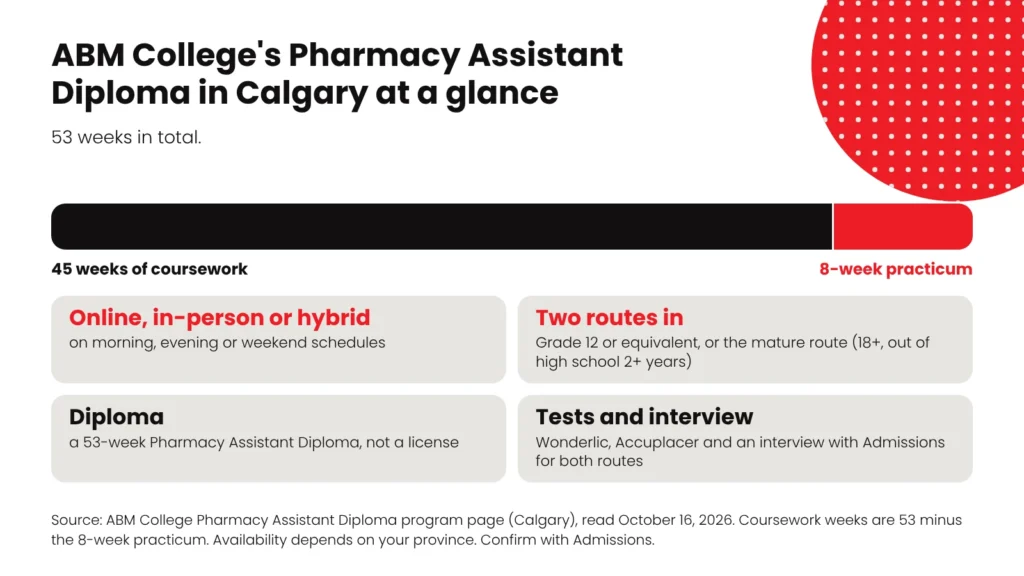
A note on the word “certificate.” Job postings and searches use certificate, diploma and certification interchangeably. They aren’t the same thing, and none of them is a license. ABM College’s Pharmacy Assistant program runs 53 weeks and awards a Pharmacy Assistant Diploma. A license, by contrast, is what a regulator issues to people in regulated roles, and the Alberta sources below don’t place pharmacy assistants in one of those roles.
Does a Pharmacy Assistant Need a License?
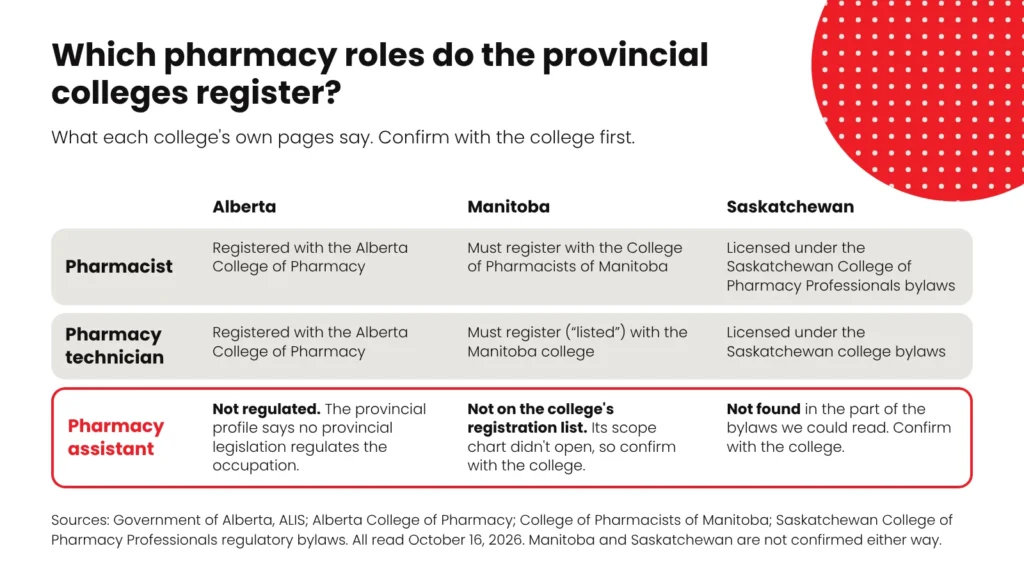
No, not in the way a pharmacist or a pharmacy technician does. The Alberta College of Pharmacy’s registration pathways cover pharmacists and pharmacy technicians. Alberta’s occupation profile says pharmacy assistants work under the supervision of one or more pharmacists or pharmacy technicians.
If you want to see where the line sits between the two roles, our guide to pharmacy assistant vs. pharmacy technician walks through it.
Sources: Alberta College of Pharmacy registration pages; Government of Alberta, ALIS occupation profile, Pharmacy Assistant (both read October 16, 2026).
Pharmacy Assistant Requirements in Alberta
Alberta is the clearest case, because the government publishes an occupation profile. In summary:
- No license or provincial certification. ALIS lists the occupation as not regulated.
- No fixed minimum education. ALIS says it varies by employer.
- Training and experience count. Employers usually prefer graduates of a related program or applicants with pharmacy experience.
- Computer skills matter. ALIS calls computer literacy and keyboarding essential.
The employer sets the bar, and a posting can ask for more than any government profile lists. The same profile also says to expect shift work, including evenings, weekends and holidays.
Source: Government of Alberta, ALIS occupation profile, Pharmacy Assistant (read October 16, 2026); Alberta College of Pharmacy registration pages (read October 16, 2026).
Manitoba and Saskatchewan: What We Could and Couldn’t Confirm
Here we’d rather tell you where our checking stopped than guess.
In Manitoba, the College of Pharmacists says every pharmacy, pharmacist, pharmacy technician and pharmacy student in the province must register with it. Pharmacy assistants aren’t on that list. The college’s technician page also points to a scope chart comparing what assistants and technicians may do, but the link didn’t open when we checked, so we can’t tell you what it says.
In Saskatchewan, the Saskatchewan College of Pharmacy Professionals’ regulatory bylaws set out registration for pharmacists, pharmacy technicians and interns. In the part of the bylaws we could read, pharmacy assistants don’t appear.
That’s not enough to call either province “unregulated,” so we won’t. Ask the college, and read a current posting, before you plan around either one. Availability of ABM’s program depends on your province, so Admissions can tell you whether it’s open to you.
Sources: College of Pharmacists of Manitoba, professional registration and pharmacy technician pages; Saskatchewan College of Pharmacy Professionals, Regulatory Bylaws (all read October 16, 2026).
What Do Employers Ask For Instead?
When no regulator sets the standard, the posting is the standard. Pharmacies decide who they hire, and what they ask for can differ between a chain, an independent and a hospital.
So before you enrol anywhere, open two or three current postings from pharmacies you’d want to work for. Shoppers Drug Mart, Costco Wholesale Pharmacy and Rexall are good places to start, alongside independents near you. Read what they ask for: training, experience, computer skills, availability. If your plan matches, you have your answer. If it doesn’t, you’ve saved yourself a year.
How to Become a Pharmacy Assistant: Four Steps
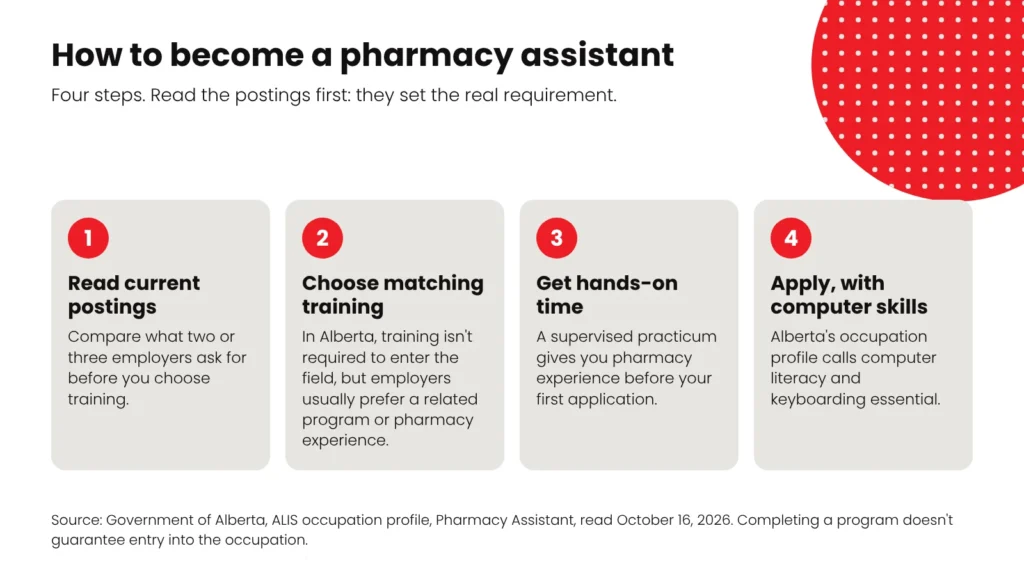
- Read current postings first. Compare what two or three employers ask for.
- Choose training that matches what you read. In Alberta, ALIS says training isn’t required to enter the field, but employers usually prefer graduates of a related program or people with pharmacy experience.
- Get hands-on time. A program with a supervised practicum gives you pharmacy experience before your first application.
- Apply, and be ready to show your computer skills. ALIS calls them essential.
What Does ABM College’s Pharmacy Assistant Diploma Involve?
The Calgary program runs 53 weeks in total and includes an eight-week practicum. It’s offered online, in person or hybrid, on morning, evening or weekend schedules, and you can read more on the Pharmacy Assistant course online page. ABM’s practicum and employer network includes pharmacies such as Shoppers Drug Mart, Costco Wholesale Pharmacy and Rexall. That’s a practicum and employer network, not a list of who hires graduates.
Admission has two routes. The standard route asks for Grade 12 or equivalent, passing scores on the Wonderlic Scholastic Level Exam and the Accuplacer test, and an interview with Admissions. The mature route is for applicants who are at least 18 and have been out of high school for at least two years, and it has the same tests and interview.
Fifty-three weeks is close to a year. Whether that suits a particular employer is the employer’s call, which is one more reason to read a posting first. Availability depends on your province, so Admissions can confirm whether the program is open to you.
ABM College’s Toronto campus has its own Pharmacy Assistant Diploma program page with the details for that campus.
Source: ABM College, Pharmacy Assistant Diploma Program in Calgary page (read October 16, 2026). Program details can change. Confirm with Admissions.
What About Employment After the Program?
ABM College reports that 70.83% of its Pharmacy Assistant graduates secured field-related employment after completing the program, based on its 2024–25 graduate outcomes (April 2024 to March 2025). The figure covers graduates from provinces across Canada, and the college submits the report to the Government of Alberta.
Read that for what it is: a reported result for one group of graduates from one college in one reporting year. It isn’t a prediction for you, and it doesn’t say how many graduates it covers or how long they took to find work. It also isn’t a promise that a diploma, or any credential, gets someone hired. Employers decide that. Ask Admissions for the underlying report and how the figure is defined.
Is This the Right Path for You?
A pharmacy assistant diploma tends to fit if:
- You want to work in a pharmacy without a pharmacy degree. Pharmacy assistants work under the supervision of a pharmacist or pharmacy technician.
- You like detail work and regular contact with the public. Accuracy and people skills both matter in the role.
- You can commit about a year. That’s 53 weeks including a practicum, and you’ll still need to apply and be hired afterward.
It’s the wrong path if you want to make clinical decisions about medications. That work belongs to pharmacists and pharmacy technicians, who are registered with their provincial college, and it takes different training. And if you need a job offer on a fixed timeline, no training program can promise one.
The Bottom Line
There’s no license standing between you and a pharmacy assistant job in Alberta. What stands between you and the job is the posting.
So read three postings this week. If what they ask matches a 53-week diploma with a supervised practicum, you can explore ABM College’s Pharmacy Assistant Diploma in Calgary, see the Toronto campus program page, look at the Pharmacy Assistant course online, or contact Admissions to check availability in your province. If it doesn’t match, you’ve lost an afternoon, not a year.
Further reading:
- What a pharmacy assistant does day to day
- What pharmacy assistants earn
- Pharmacy assistant vs. pharmacy technician
Frequently Asked Questions
Do you need a certificate to be a pharmacy assistant in Alberta? Not by law. The Government of Alberta’s occupation profile says there is no provincial legislation regulating the occupation and lists the minimum education as “varies.” It says employers usually prefer graduates of a related training program or people with pharmacy experience, so check the posting for the specific role.
Does a pharmacy assistant need a license? Not in the way pharmacists and pharmacy technicians do. The Alberta College of Pharmacy’s registration pathways cover pharmacists and pharmacy technicians, and Alberta’s occupation profile lists no license or registration for pharmacy assistants.
Do you need training to work as a pharmacy assistant? In Alberta, the occupation profile says employers usually prefer graduates of a related training program or people with pharmacy experience, and that computer literacy and keyboarding skills are essential. It also says completing a program doesn’t guarantee entry into the occupation, so read current postings first.
What is the difference between a pharmacy assistant and a pharmacy technician? Pharmacy technicians register with their provincial college. In Alberta, that is the Alberta College of Pharmacy. Alberta’s occupation profile says pharmacy assistants work under the supervision of one or more pharmacists or pharmacy technicians. See our guide to pharmacy assistant vs. pharmacy technician for the full comparison.
How long is ABM College’s Pharmacy Assistant Diploma in Calgary? 53 weeks in total, including an eight-week practicum. Contact Admissions to confirm availability in your province.
What is the employment rate for ABM College’s Pharmacy Assistant graduates? ABM College reports that 70.83% of its Pharmacy Assistant graduates secured field-related employment after completing the program, based on its 2024–25 graduate outcomes (April 2024 to March 2025), which cover graduates from across Canada and are submitted to the Government of Alberta. That is a past result for one group of graduates, not a prediction or a guarantee for you. Ask Admissions for the report and how “field-related” is defined.
About The Author

Kiran Vijay leads SEO at ABM College, working alongside admissions advisors and program teams across the Calgary, Winnipeg, and Toronto campuses. With 10+ years in SEO, paid search, and content strategy for Canadian post-secondary education, Kiran writes about diploma programs, career outcomes, and the job market for career college graduates — grounded in ABM College’s own enrolment and graduate employment data reported to Alberta Advanced Education. Connect on LinkedIn.