
Posted on October 8, 2026 in
Health
The short answer: in Alberta, there’s no licence or provincial certificate required to become an education assistant, in Manitoba the province leaves hiring requirements to each school division, and in Saskatchewan divisions post their own requirements. In Alberta, employers generally prefer a high school diploma plus related post-secondary training. The longer answer depends on where you live and which school division you want to work for, so here’s what we could confirm from official sources, and where you’ll need to read a current job posting yourself.
If you’re searching “how to become an educational assistant,” you’re probably really asking three questions: Do I need a certificate or diploma? Does the answer change by province? And how long will it take before I can apply? Here’s the plain-terms version of each.
Do You Need a Certificate or Diploma to Be an Educational Assistant?
Not by law, in Alberta. The Government of Alberta’s occupation profile says educational assistants are not regulated there and that no provincial legislation governs the occupation. The same profile lists one year of post-secondary education as the minimum education and says employers generally prefer a high school diploma plus related post-secondary training. It also notes that a first aid certificate, a criminal record check and a child intervention record check may be required.
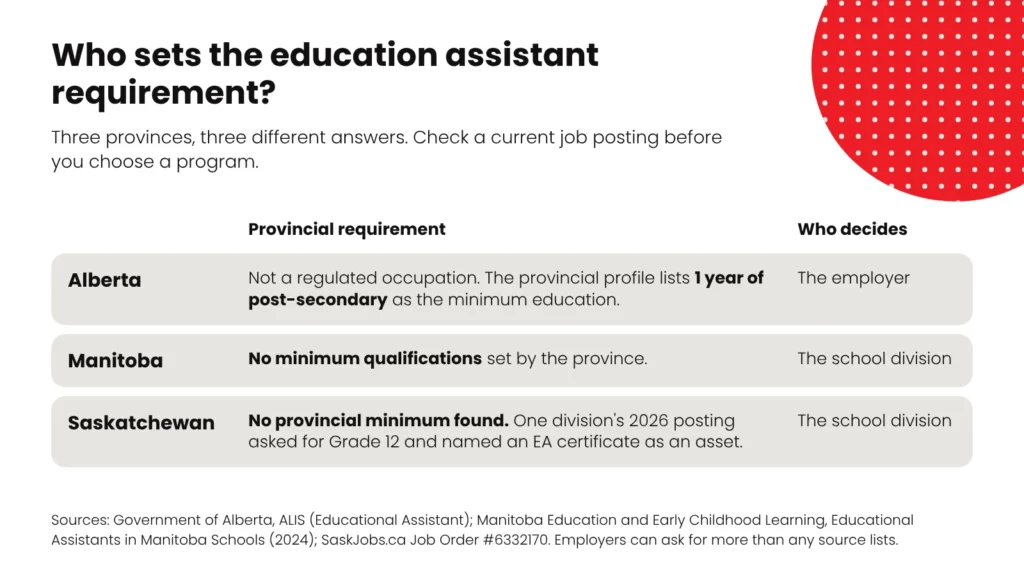
Unregulated doesn’t mean no requirements. The employer sets the bar, and a school division’s posting can ask for more than the provincial profile lists. Read the posting before you plan your training.
Educational Assistant Requirements in Alberta: The Four Steps
Four steps, in order:
- Finish high school or an equivalent. It’s the starting point employers look for.
- Complete related post-secondary training. Alberta’s profile lists one year as the minimum education. A program with a supervised practicum also gives you classroom time before your first application.
- Expect checks. A criminal record check, a child intervention record check and first aid may be asked for, depending on the employer.
- Apply to the division you want. Divisions post their own requirements. Compare two or three current postings before you choose a program.
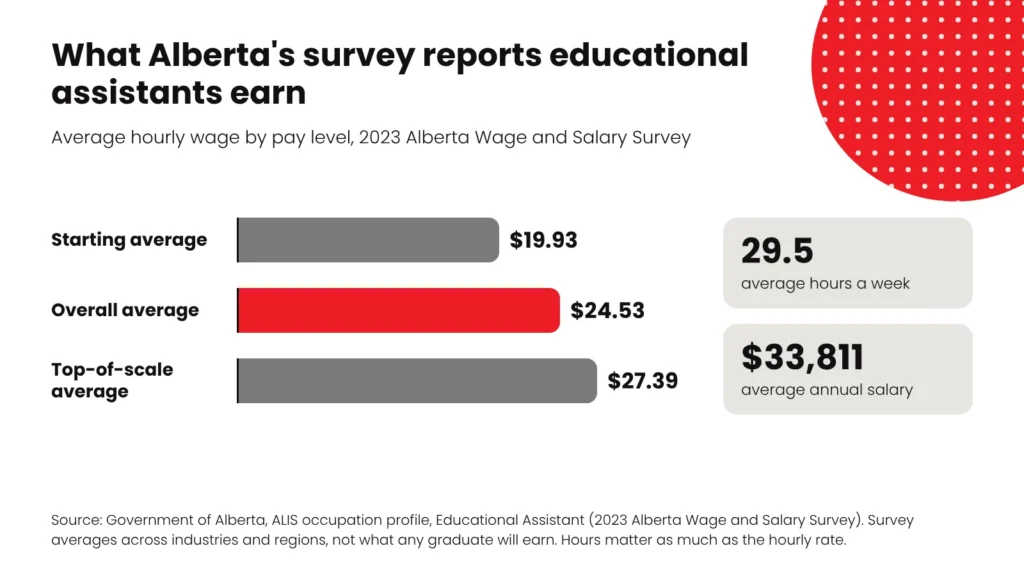
What does that pay? Alberta’s occupation profile reports an average of $24.53 an hour across industries and regions, with a starting average of $19.93 and a top-of-scale average of $27.39 (2023 Alberta Wage and Salary Survey). It also reports an average of 29.5 hours a week and an average annual salary of $33,811. That’s worth reading twice: hours matter as much as the hourly rate, and pay varies widely across the province. For national figures, see our guide to education assistant duties and wages in Canada.
Source: Government of Alberta, ALIS occupation profile, Educational Assistant. Wage data: 2023 Alberta Wage and Salary Survey. Averages describe the survey, not what any graduate will earn.
What about Alberta employment data? ABM College reports that 75.61% of its Education Assistant graduates secured field-related employment after completing the program. The college cites the Alberta Advanced Education Institution Annual Report (PAPRS432) for April 2024 to March 2025. [CONFIRM the figure, cohort size and definition of "field-related" against the report itself before publishing.] Read it for what it is: a reported result for one group of graduates from one college in one reporting period. It isn’t a prediction for you or a promise of a job, and it doesn’t say how many graduates the figure covers. Ask Admissions for the report and those details.
How to Become an Educational Assistant in Manitoba
Manitoba works differently, and the province says so plainly. Its 2024 guide, Educational Assistants in Manitoba Schools, doesn’t set minimum qualifications. School divisions are responsible for hiring practices, job titles, and orientation and training requirements. EAs work under the direction of a principal or a teacher the principal designates, under Manitoba Regulation 23/2000.
What that means for you: there’s no single Manitoba standard to meet. The requirement is whatever the division posts. Divisions use different job titles for similar work, so search for more than one title when you look at openings.
Source: Manitoba Education and Early Childhood Learning, Educational Assistants in Manitoba Schools (2024).
How to Become an Educational Assistant in Saskatchewan
We haven’t found a provincial minimum for Saskatchewan, so we’re not going to invent one. School divisions post their own educational assistant roles, and the requirements sit in each posting. Titles vary too: Saskatchewan Rivers School Division’s September 2026 posting was for an “Educational Associate 1.”
That posting listed successful completion of Grade 12 as a requirement. It named a one-year post-secondary Educational Assistant certificate, a two-year Early Childhood Education diploma, a two-year Youth Care Worker diploma or equivalent post-secondary education as assets, and it asked for experience in the delivery of human services. It was one division’s posting for one position, and it’s now closed, so use it as an example of what divisions ask, not as a rule. Saskatoon Public Schools, for example, lists openings by role, including Educational Assistant, Educational Assistant – Hearing Loss and Educational Assistant – Vision Loss.
The practical move is the same as elsewhere: open a current posting from the division you want to work for and read the requirements before you choose a program.
Sources: SaskJobs.ca, Job Order #6332170, Saskatchewan Rivers School Division #119 (posted 15 September 2026, closed to applications); Saskatoon Public Schools careers page. Division postings change often.
How Long Does Training Take?
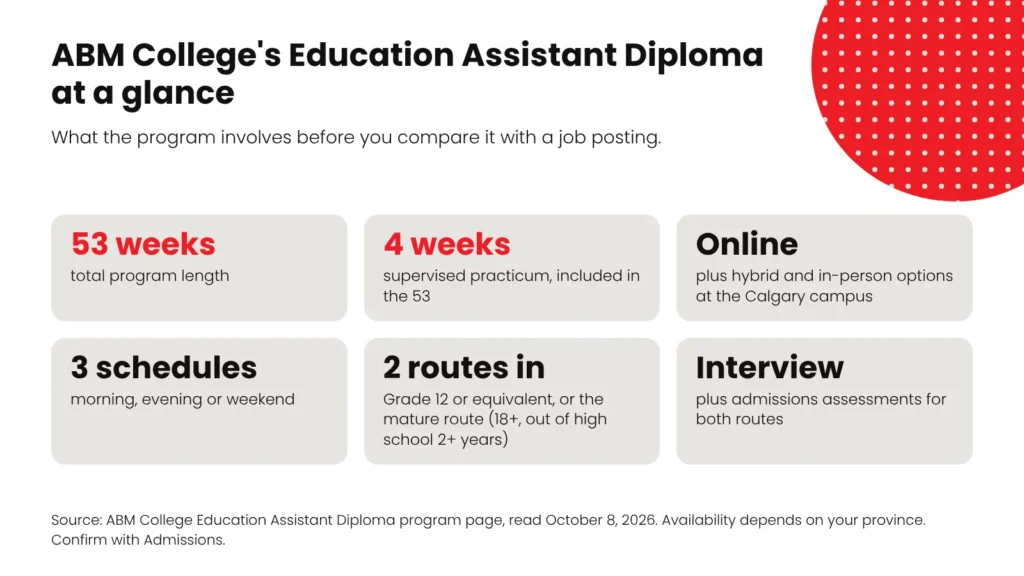
It depends on the program. ABM College’s Education Assistant Diploma runs 53 weeks, including a four-week supervised practicum. It’s offered online, with hybrid and in-person options at the Calgary campus, on morning, evening or weekend schedules. Availability depends on your province, so Admissions can confirm whether the program is open to you.
Admission has two pathways: a standard route (Grade 12 or equivalent) and a mature route for applicants who have been out of high school for at least two years and are 18 or older. Both involve admissions assessments and an interview.
Fifty-three weeks is close to a year. Whether that satisfies a particular division is the division’s call, not ours, which is one more reason to read a posting first.
Is This the Right Path for You?
This path tends to fit if:
- You want to work beside a teacher and support students directly, one-on-one or in small groups, rather than lead your own classroom.
- You can commit about a year to training, including a practicum placement.
- You’re comfortable with variable hours. Alberta’s profile reports an average of 29.5 hours a week, so don’t plan around a full-time schedule from day one.
It’s a different call if you want to teach your own class. That takes a teaching credential, and an EA role doesn’t replace it. It’s also the wrong plan if you need a fixed full-time income immediately.
The Honest Version
There isn’t a national rulebook for becoming an educational assistant. In Alberta it’s an unregulated occupation with a one-year post-secondary minimum listed by the province. In Manitoba, your division decides. Elsewhere, the posting decides.
So before you enrol anywhere, open two or three current postings from the divisions you’d want to work for and read what they ask. If your plan matches, you have your answer. If it doesn’t, you’ve saved yourself a year. If it does, you can explore ABM College’s educational assistant course online in Alberta, or contact Admissions to check availability in your province. If funding is the question, ABM’s financial aid page explains the options and eligibility rules.
Further reading:
Frequently Asked Questions
Do you need a certificate to be an educational assistant in Alberta?
Not by law. Alberta’s occupation profile says the occupation isn’t regulated there. It lists one year of post-secondary education as the minimum education and says employers generally prefer a high school diploma plus related post-secondary training, so check the posting for the specific role.
Do you need a degree to be an educational assistant?
Alberta’s occupation profile lists one year of post-secondary education as the minimum education, not a degree. In Manitoba, the province sets no minimum and school divisions decide. Employers can ask for more than either source lists.
Who decides educational assistant requirements in Manitoba?
School divisions. Manitoba Education and Early Childhood Learning’s 2024 guide assigns hiring practices and orientation and training requirements to divisions rather than setting a provincial minimum.
How long is ABM College’s Education Assistant Diploma?
53 weeks, including a four-week supervised practicum. Contact Admissions to confirm availability in your province.
How much do educational assistants make in Alberta?
Alberta’s occupation profile reports an average of $24.53 an hour (starting average $19.93, top average $27.39) and an average of 29.5 hours a week, from the 2023 Alberta Wage and Salary Survey. These are survey averages, not a promise of what any individual will earn.
About The Author

Kiran Vijay leads SEO at ABM College, working alongside admissions advisors and program teams across the Calgary, Winnipeg, and Toronto campuses. With 10+ years in SEO, paid search, and content strategy for Canadian post-secondary education, Kiran writes about diploma programs, career outcomes, and the job market for career college graduates — grounded in ABM College’s own enrolment and graduate employment data reported to Alberta Advanced Education. Connect on LinkedIn.