
Posted on September 15, 2026 in
Health
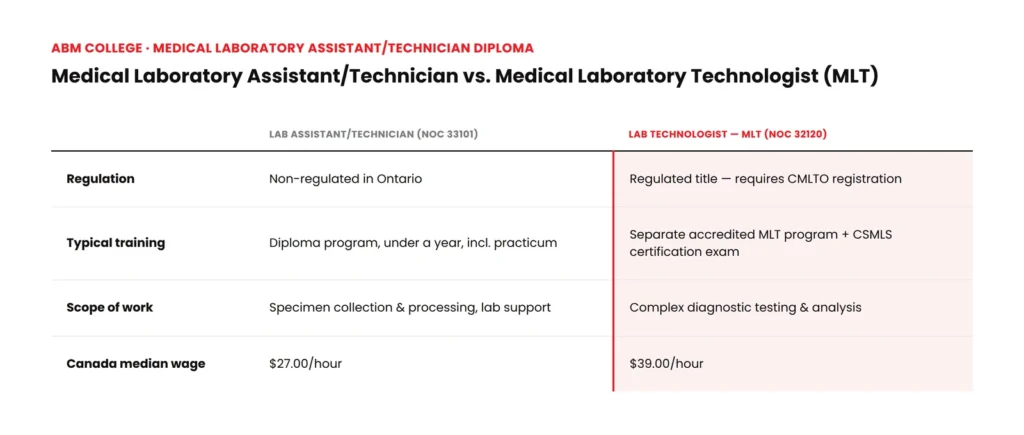
If you’ve been looking at lab careers, you’ve probably seen “medical laboratory assistant,” “medical laboratory technician,” and “medical laboratory technologist (MLT)” used almost interchangeably in job postings and course listings. They’re not the same job, and in Ontario they’re not even in the same regulatory category. The short version: a medical laboratory assistant/technician (MLA/T) is a non-regulated support role that trains in under a year and does not require a licence to work, while a medical laboratory technologist (MLT) is a regulated health profession in Ontario — the title is legally protected, and using it without registration with the College of Medical Laboratory Technologists of Ontario (CMLTO) is something the College actively investigates.
That distinction matters more than it might sound like it does, because it changes what you can legally call yourself, what tasks you’re allowed to perform, how long training takes, and what the role pays.
What Does a Medical Laboratory Assistant/Technician Do?
Under Canada’s National Occupational Classification, this role falls under NOC 33101 — Medical laboratory assistants and technicians, a non-regulated occupation in Ontario. MLA/Ts typically work under the supervision of an MLT or lab manager, and the role commonly includes:
- Specimen collection and processing (including phlebotomy — drawing blood)
- Preparing samples for testing and routing them to the right department
- Basic lab administration and data entry
- Equipment maintenance and lab safety support
- In some settings, straightforward pre-analytical tasks under supervision
Common job titles for this NOC code include Medical Laboratory Assistant, Medical Laboratory Aide, Phlebotomist, Phlebotomy Aide, and Specimen Processing Technician — all support-level roles, not the regulated technologist title.
What Does a Medical Laboratory Technologist (MLT) Do?
Medical Laboratory Technologists fall under NOC 32120, a distinct, regulated occupation. MLTs perform the complex technical analysis a lab depends on — running and interpreting chemistry, hematology, microbiology, and blood bank testing, operating and troubleshooting analytical instruments, and validating results that physicians act on directly. In Ontario, this work is regulated under the Regulated Health Professions Act, 1991 and the Medical Laboratory Technology Act, overseen by CMLTO.
“Medical Laboratory Technologist” is a legally protected title in Ontario. You cannot call yourself an MLT, or perform the profession’s controlled acts, without being registered with CMLTO — CMLTO’s own public materials note it has received close to 200 complaints about non-MLTs since 2020, which gives a sense of how seriously title protection is enforced. Becoming a registered MLT generally means completing a separate, accredited MLT education program, passing the national certification exam administered by the Canadian Society for Medical Laboratory Science (CSMLS), and then applying for CMLTO registration — a longer and different pathway than an MLA/T diploma, not a next step you complete just by working in the assistant role for a while.
Is a Medical Laboratory Assistant the Same as a Lab Technician?
In everyday use, mostly yes — “medical laboratory assistant” and “medical laboratory technician” are typically used to describe the same non-regulated role, and Job Bank groups them under the same NOC code (33101). Neither title is regulated in Ontario today. (Worth knowing for context: Nova Scotia became the first province to regulate this role, effective May 3, 2026, under the Nova Scotia Medical Laboratory Technology Act — a sign the landscape could shift elsewhere over time, but as of this writing, Ontario has not followed.) CMLTO also operates a voluntary roster that Ontario MLA/Ts can choose to join — joining it is optional recognition, not a licence, and it isn’t required to work in the role.
How Much Does Each Role Pay?
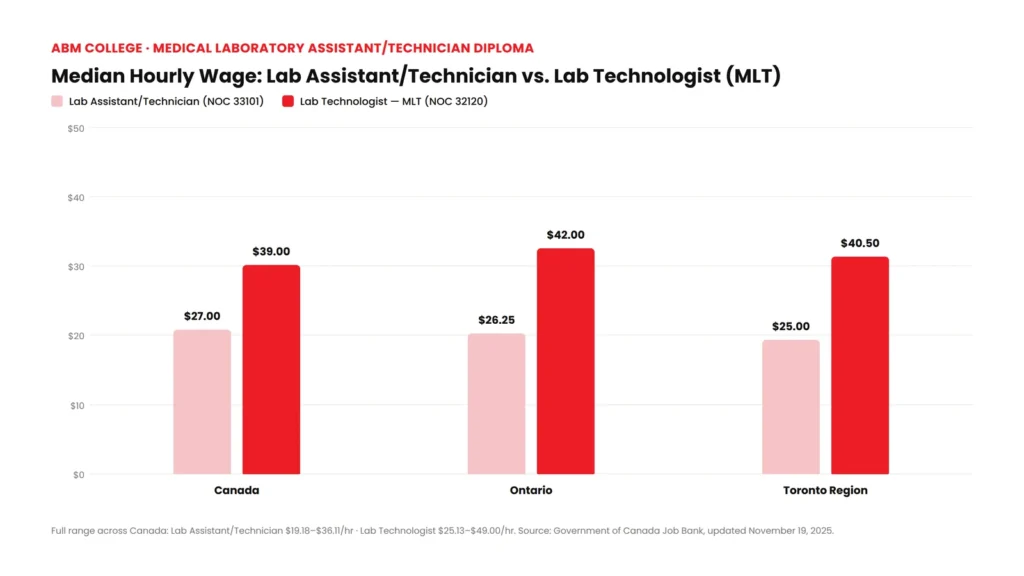
Real, current numbers from Government of Canada Job Bank, updated November 19, 2025:
| Region | Medical Laboratory Assistant/Technician (NOC 33101) | Medical Laboratory Technologist (NOC 32120) |
|---|---|---|
| Canada-wide | Low $19.18 / Median $27.00 / High $36.11 | Low $25.13 / Median $39.00 / High $49.00 |
| Ontario | Low $17.62 / Median $26.25 / High $36.00 | Low $23.00 / Median $42.00 / High $50.00 |
| Toronto Region | Low $17.60 / Median $25.00 / High $36.25 | Low $18.57 / Median $40.50 / High $50.00 |
Source: Government of Canada Job Bank, Labour Market Information Survey, wages updated November 19, 2025.
The gap is real and consistent across every geography: MLT median pay runs roughly 50–60% higher than MLA/T median pay in the same region. That’s the trade-off against the shorter, non-regulated training path — MLA/T training is faster and doesn’t require passing a national certification exam or provincial registration, but the ceiling on the role (and the pay that comes with it) is lower than the regulated technologist role.
Which One Should You Train For?
A medical laboratory assistant/technician path may suit you if:
- You want to get into a clinical lab environment sooner rather than later
- You’re comfortable with a support-level scope of practice (specimen collection and processing, not complex test analysis)
- You want to see if lab work is a fit before committing to a longer, regulated credential
Aiming for Medical Laboratory Technologist means a longer, separate road:
- A full MLT education program (distinct from and longer than an MLA/T diploma), CSMLS certification, and CMLTO registration
- Working as an MLA/T does not, on its own, make you eligible for MLT registration — check directly with CMLTO and an accredited MLT program for the actual entry requirements before assuming any credit applies
- The payoff is a regulated title, a broader scope of practice, and meaningfully higher pay
ABM College’s Medical Laboratory Assistant/Technician Diploma
ABM College’s Medical Laboratory Assistant/Technician Diploma in Toronto is a 55-week, in-person program at the Scarborough campus, including a 4-week (160-hour) practicum in laboratories and walk-in clinics. Coursework covers anatomy and physiology, clinical chemistry and urinalysis, phlebotomy and blood-drawing skills, ECG/Holter monitoring, hematology and blood bank, microbiology, and a capstone career-prep module, alongside CPR/first aid certification.
Said plainly, because it matters: this diploma prepares graduates for MLA/T-level roles. It does not provide CMLTO registration or MLT licensure, and completing it does not make someone a Medical Laboratory Technologist. The program’s own ethics course introduces CMLTO and Medical Laboratory Professionals’ Association of Ontario (MLPAO) standards of practice as professional context — it does not register graduates with either body.
Frequently Asked Questions
What is the difference between a medical laboratory assistant and a medical laboratory technologist? A medical laboratory assistant/technician (NOC 33101) is a non-regulated support role focused on specimen collection, processing, and basic lab support. A medical laboratory technologist (NOC 32120) is a regulated health profession in Ontario that performs complex diagnostic testing and analysis, requires CMLTO registration, and pays roughly 50–60% more at the median across Canada, Ontario, and Toronto.
Is “medical laboratory technologist” a protected title in Ontario? Yes. MLT is regulated under the Regulated Health Professions Act, 1991 and the Medical Laboratory Technology Act, overseen by the College of Medical Laboratory Technologists of Ontario (CMLTO). Using the title or performing the profession’s controlled acts without CMLTO registration is not permitted.
Does a medical laboratory assistant/technician diploma lead to becoming an MLT? Not on its own. Becoming a registered MLT means completing a separate, accredited MLT education program, passing the CSMLS national certification exam, and registering with CMLTO. Working as an MLA/T doesn’t automatically count toward that — confirm current requirements directly with CMLTO and an accredited MLT program.
How much does a medical laboratory assistant make in Ontario? Job Bank reports an Ontario median of $26.25/hour for NOC 33101 (low $17.62, high $36.00), and a Toronto Region median of $25.00/hour, both updated November 19, 2025.
How much does a medical laboratory technologist make in Ontario? Job Bank reports an Ontario median of $42.00/hour for NOC 32120 (low $23.00, high $50.00), and a Toronto Region median of $40.50/hour, both updated November 19, 2025.
About The Author

Kiran Vijay leads SEO at ABM College, working alongside admissions advisors and program teams across the Calgary, Winnipeg, and Toronto campuses. With 10+ years in SEO, paid search, and content strategy for Canadian post-secondary education, Kiran writes about diploma programs, career outcomes, and the job market for career college graduates — grounded in ABM College’s own enrolment and graduate employment data reported to Alberta Advanced Education. Connect on LinkedIn.