
Posted on August 24, 2026 in
Technology
If you’re comparing cybersecurity training options and searching for “ethical hacking classes” or “penetration testing classes,” here’s the direct answer: ABM College’s Cybersecurity Diploma does not have a course called “Ethical Hacking” or “Penetration Testing.” It teaches the underlying skills — network defence, security analysis, and hands-on lab work — through courses like Network and Computer Security, Cyber Security Fundamentals, and Cisco Networking, and through a supervised practicum. Graduates can pursue roles that use these skills, including junior penetration testing positions, but the diploma is a general cybersecurity credential, not a specialized ethical-hacking certification program.
The rest of this article explains what ethical hacking and penetration testing actually are, how they relate to each other, and exactly where each shows up in ABM’s curriculum — so you can judge for yourself whether this program matches what you’re looking for.
What is ethical hacking?
Ethical hacking is the practice of testing computer systems, networks, or applications for security weaknesses — using the same techniques a malicious attacker would — but with authorization from the system’s owner and the goal of reporting and fixing the weaknesses found, not exploiting them.
An ethical hacker’s work can include scanning networks for open ports and outdated software, testing whether passwords or access controls can be bypassed, and checking whether an organization’s staff fall for phishing attempts. The umbrella term for this work is often “offensive security.”
What is penetration testing, and how is it different?
Penetration testing (or “pen testing”) is a specific, structured type of ethical hacking. Instead of an open-ended search for any weakness, a penetration test has a defined scope, a set time window, and a specific target — for example, “test whether an attacker on the guest Wi-Fi network can reach the payroll server.” The tester documents each step and delivers a report ranking the weaknesses found by severity.
In short: ethical hacking is the broader practice; penetration testing is one common, scoped way of doing it. Most job postings use the terms loosely and interchangeably, so don’t read too much into which word an employer uses.
Where do these skills fit in ABM’s Cybersecurity Diploma?
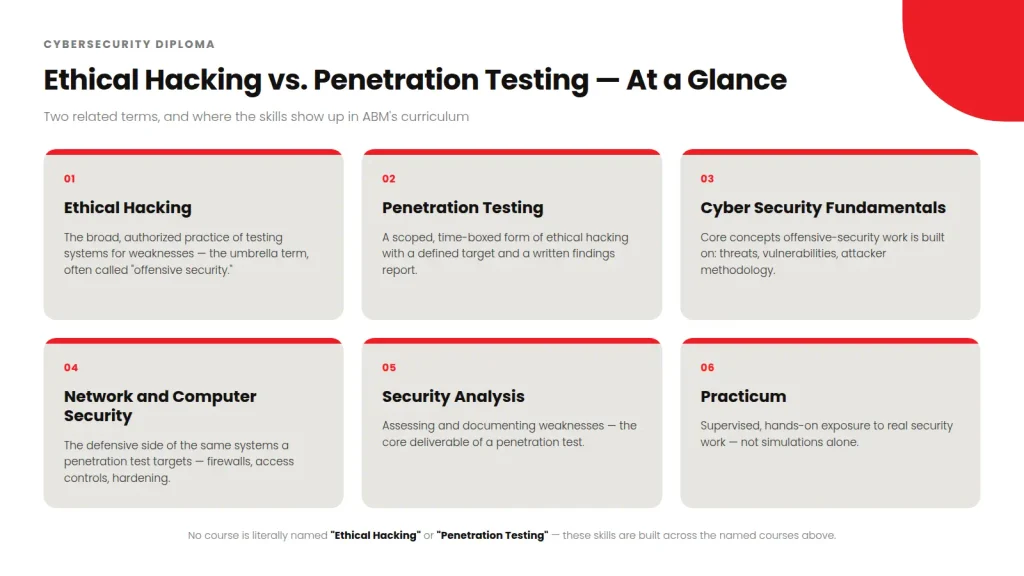
ABM’s Cybersecurity Diploma (Calgary campus, Alberta-licensed program: 70 weeks / 1,500 hours — confirm hours figure, see compliance flags) is built as a broad, foundational cybersecurity credential — not a single-specialization ethical-hacking or pen-testing bootcamp. The table below shows which named courses in the program relate to these skills, and how.
| ABM course (as named on the program page) | How it relates to ethical hacking / penetration testing |
|---|---|
| Cyber Security Fundamentals | Introduces the core concepts offensive-security work is built on: threats, vulnerabilities, and attacker methodology. |
| Network and Computer Security | Covers the defensive side of the same systems a penetration test targets — firewalls, access controls, and hardening. |
| Cisco Networking – Routing & Switching | Builds the networking foundation needed to understand how an attacker — or a tester — moves through a network. |
| Network+ (certification-aligned course) | Reinforces that same networking foundation against an industry-recognized certification objective. |
| Security Analysis | Covers assessing and documenting security weaknesses, the core deliverable of a penetration test. |
| Mobile Device Security | Extends the same testing mindset to phones and tablets, an increasingly common pen-testing target. |
| Practicum (supervised workplace experience) | Gives students hands-on exposure to real security work in a supervised setting, rather than simulations alone. |
The limitation, stated plainly: none of these courses is a dedicated, named “Ethical Hacking” or “Penetration Testing” course. If your goal is a deep, specialized pen-testing credential specifically, compare this program’s course list above against what you’re looking for before enrolling. Many working penetration testers build on a foundational diploma like this one with further third-party certification study after graduation — that additional step is not included in this program.
Can this diploma lead to a penetration-testing job?
ABM’s own program materials list Junior Penetration Tester as one of the roles this diploma prepares students for, alongside other entry-level cybersecurity roles. That is a description of what the program prepares you for, not a guarantee: hiring outcomes depend on the employer, the job market at the time, and the individual candidate. ABM provides career-support services — including résumé preparation and interview practice — to help graduates in their job search, not a placement guarantee.
If you want a closer look at how penetration-testing-style roles compare to defensive (“blue team”) roles, and what each pays and involves, see Cyber Security Red Team vs. Blue Team: Job Opportunities (confirm live) and Cybersecurity Jobs: Types and Salary (confirm live).
Where is this program offered?
- Calgary, Alberta: Cybersecurity Diploma, 70 weeks / 1,500 hours (confirm hours figure).
- Toronto, Ontario: Cybersecurity Diploma, 70 weeks.
- Winnipeg, Manitoba: Cybersecurity is a currently registered program with Manitoba’s Private Vocational Institutions Branch, delivered in class, online, and blended. Check the Winnipeg Cybersecurity Diploma page for current duration and delivery details before applying.
If “classes near me” is what actually brought you here, the campus pages above — not this article — have the enrolment details, schedules, and local contact information.
Delivery format, exact duration, and admission requirements can differ by campus — confirm the details on your campus’s program page rather than assuming they match another province.
Frequently asked questions
Is ethical hacking part of ABM’s Cybersecurity Diploma? The concepts behind ethical hacking — vulnerability assessment, network security, security analysis — are covered across several named courses. There is no course titled “Ethical Hacking” specifically.
What’s the actual difference between ethical hacking and penetration testing? Ethical hacking is the broad practice of authorized security testing. Penetration testing is a specific, scoped, time-boxed form of ethical hacking with a defined target and a written report. In everyday use, the two terms are often used interchangeably.
Do I need to already know how to code or use Linux before enrolling? This is a foundational diploma, and no prior cybersecurity experience is assumed. Confirm current admission requirements on the program page for your campus.
Is this program available in Winnipeg? Yes. Cybersecurity is one of two programs currently listed on Manitoba’s public PVI registry for ABM, delivered in class, online, and blended. Confirm current duration and delivery details on the Winnipeg program page.
The real distinction, one more time
Ethical hacking is the mindset and the umbrella; penetration testing is one disciplined way of applying it. ABM’s Cybersecurity Diploma teaches the mindset — through defensive and offensive fundamentals, networking, and hands-on lab and practicum work — without promising a specialized pen-testing credential it doesn’t offer. If that broad foundation is what you’re looking for before you specialize, this program fits. If you already know you want a dedicated, named ethical-hacking or pen-testing certification and nothing else, this diploma is the wrong first stop — say that to yourself now rather than after enrolling.
Ready to see the full course list and admission requirements? Visit the Cybersecurity Diploma program page →
About The Author

Kiran Vijay leads SEO at ABM College, working alongside admissions advisors and program teams across the Calgary, Winnipeg, and Toronto campuses. With 10+ years in SEO, paid search, and content strategy for Canadian post-secondary education, Kiran writes about diploma programs, career outcomes, and the job market for career college graduates — grounded in ABM College’s own enrolment and graduate employment data reported to Alberta Advanced Education. Connect on LinkedIn.