
Posted on August 17, 2026 in
Health
If you’re looking at this diploma, you probably want a straight answer before you want anything else: once you’re done, where do you actually go to work? The short version is that this diploma is designed to prepare you for front-line, non-clinical support roles — inside community agencies, residential and outreach programs, family service organizations, school-based supports, and some justice-adjacent settings. These are support and case-work roles, not licensed counselling or clinical positions, and that distinction matters for how you should think about the diploma.
ABM offers the Addictions and Community Service Worker Diploma as a 56-week program at its Calgary and Toronto campuses. It is not offered at the Winnipeg campus.
Below are the work settings the diploma prepares you for, what the work looks like day to day, and what to check before you assume a given setting is open to you.
This is support work, not clinical treatment
Worth saying clearly up front: an addictions and community service worker is not the same role as a registered addictions counsellor, social worker, or clinician. Some employers and provinces require additional certification, registration, or supervised hours before you can take on clinical or independently licensed responsibilities. What this diploma prepares you for is the front-line support layer underneath that — the people who do intake, case coordination, crisis response, group facilitation, and day-to-day client support inside programs run by clinicians, agency management, or multidisciplinary teams. That’s a real and needed job. It’s just not the same job as a licensed counsellor, and no program should tell you otherwise.
Community outreach and support worker roles
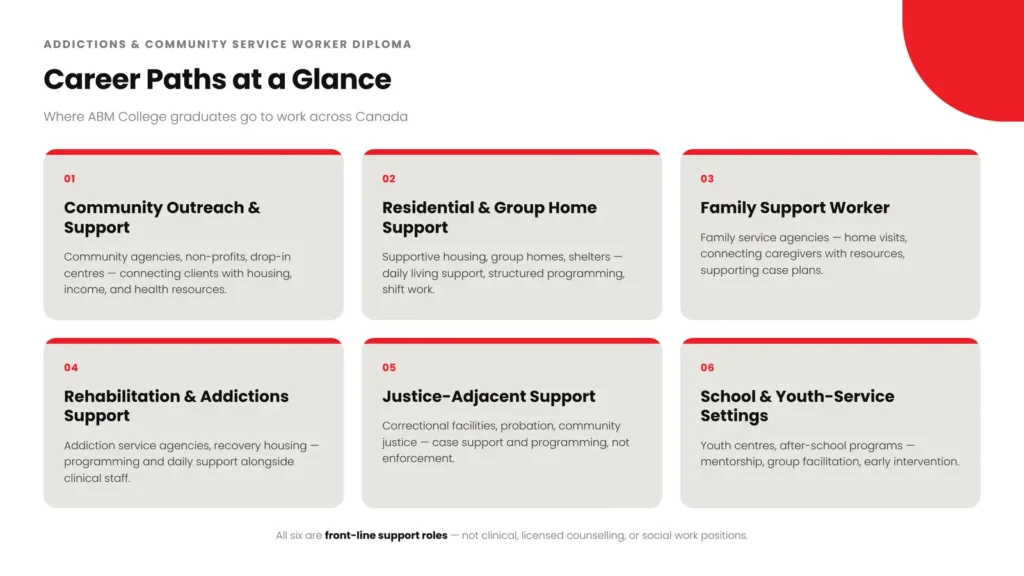
Community agencies and non-profit outreach programs are a core employer of workers with this kind of training. These are roles at drop-in centres, community health organizations, and non-profits that run outreach, referral, and case-support programs. The work typically involves connecting clients with housing, income support, health, or treatment resources, keeping case notes, and coordinating with other service providers. It’s relationship-heavy work — you’re often the consistent point of contact for someone navigating several systems at once.
Residential and group home support worker roles
Supportive housing, group homes, and shelters hire community service workers to support daily living, safety, and structured programming. In these settings, the work includes monitoring and supporting residents through their daily routines, de-escalating conflict, running structured activities or life-skills programming, and documenting incidents and progress for the clinical or supervisory team. Shift work is common in residential settings, which is worth factoring in if you’re weighing this path against something with more predictable hours.
Family support worker roles
Family support worker is one of the more direct applications of this diploma, and it’s usually where the program’s coursework on supporting youth and families comes in. Family service agencies and community family resource centres hire workers to do home visits, connect parents and caregivers with community resources, and support case plans set by a social worker or program supervisor. If working with families and kids specifically is your reason for considering this field, this is the path to ask ABM’s admissions team about directly — it’s a named, hireable role, not just a theme that runs through the coursework.
Rehabilitation and addictions support worker roles
Addiction service agencies and transitional or recovery housing programs hire community service workers into support roles that sit alongside — not instead of — clinical counselling staff. Typical duties include running structured programming, supporting clients through daily routines during treatment or recovery, and coordinating logistics with the clinical team. This is the closest career path to “addictions worker” in the literal sense, and it’s also where the clinical-versus-support distinction matters most: independent addictions counselling generally requires additional certification or registration beyond this diploma, depending on the province and the employer. Many people use this role as the entry point into the field, then pursue further credentialing later if they want to move into counselling specifically.
Justice-adjacent and correctional support roles
Justice-adjacent settings also hire community service workers into support roles — for example, in correctional facilities, probation offices, or community justice programs, doing case support, programming, or liaison work rather than security or enforcement duties. These settings often have their own hiring requirements on top of the diploma, including security clearances and sometimes additional sector-specific training, so this is a path to research with the specific employer rather than assume is automatically open once you graduate.
School and youth-service settings
Youth centres, after-school programs and school-based supports are another setting where this training applies, particularly for graduates drawn to prevention and early-intervention work rather than crisis response. The work here tends to look like mentorship, group facilitation, and connecting students and families with additional supports when needed.
How an addictions worker program like ABM’s actually prepares you for these paths
ABM College’s Addictions and Community Service Worker Diploma is built for the front-line support layer across several of these settings rather than a single fixed job title. The program combines classroom coursework with a supervised practicum placement. The practicum provides supervised workplace experience in one of these settings. Confirm the current practicum length and placement process with ABM Admissions, since these details are set by the program. If you’re comparing your options before applying, ABM’s Addictions and Community Service Worker Diploma page has the current details on delivery format, coursework, admission requirements, and campus availability — worth a direct read rather than relying on secondhand summaries, including this one.
It’s also worth being honest about the ceiling here: this diploma prepares you to enter the field. It doesn’t replace a social work degree, a clinical counselling credential, or provincial licensing where a specific role requires it. Some of the paths above — particularly clinical addictions counselling and some justice-sector roles — have their own additional requirements on top of what this program covers. Treat the diploma as the entry point it’s designed to be, not the finish line.
Which path actually fits you?
None of the paths above are “better” than the others — they suit different people. If steady, structured environments and daily routines appeal to you, residential and group home work is worth a closer look. If you’d rather be moving between agencies and coordinating resources than working inside one building, community outreach is the closer fit. If working with kids and parents is the draw, family support work is the direct route. And if you’re specifically interested in the addictions side of the field, understand going in that this diploma is your entry point into support work in that space — not a substitute for the clinical credential that independent counselling roles usually require.
Frequently asked questions
Do you need a licence to work as an addictions and community service worker?
No. Addictions and community service worker roles are generally non-clinical, non-licensed support positions. Some specific settings or responsibilities — for example, independent addictions counselling or certain justice-sector roles — may require additional certification, registration, or clearance beyond this diploma, depending on the province and the employer.
Is this the same as a social worker?
No. A social worker is a distinct, separately regulated profession with its own licensing requirements. An addictions and community service worker provides front-line support — intake, case coordination, crisis response, and day-to-day client support — typically working alongside social workers, clinicians, or program supervisors rather than in their place.
Can you work in addictions treatment with this diploma?
Yes, in a support capacity. Graduates can pursue roles at addiction service agencies and transitional or recovery housing programs that sit alongside, not instead of, clinical counselling staff. Independent addictions counselling generally requires additional certification or registration beyond this diploma.
How long is the program?
ABM’s Addictions and Community Service Worker Diploma is a 56-week program, offered at ABM’s Calgary and Toronto campuses. It is not offered at the Winnipeg campus.
If you want to talk through which of these settings makes sense for where you are right now, ABM’s admissions team can walk you through the current program details, campus options, and what a typical practicum placement looks like. You can also read more about why other students chose this path and what current community service workers in Canada say about the benefits of the work if you’re still deciding whether this field is the right fit at all before you get into the “where do I work” question.
About The Author

Kiran Vijay leads SEO at ABM College, working alongside admissions advisors and program teams across the Calgary, Winnipeg, and Toronto campuses. With 10+ years in SEO, paid search, and content strategy for Canadian post-secondary education, Kiran writes about diploma programs, career outcomes, and the job market for career college graduates — grounded in ABM College’s own enrolment and graduate employment data reported to Alberta Advanced Education. Connect on LinkedIn.